Saturday, June 23, 2012

Israel Day 7


This day was a big day!  We snuck down to the beach for a last float on the Dead Sea before hopping on the bus for a monumental ride north along the Dead Sea, with stops at En Gedi, Qumran, and then a memorable trek from Jericho to Jerusalem!

En Gedi was beautiful, and I could just picture David there, running from Saul, finding him in one of the caves.  En Gedi (meaning Spring of the Goats) is an oasis in an otherwise barren wilderness.

The spring

The Biblical hyrax!  (aka rock badger)

En Gedi caves


Qumran was amazing.  The Dead Sea Scrolls were discovered in a cave there in 1947 by a Bedouin shepherd.  The scrolls had been hidden in the cave by the sect called the Essenes in the first century, presumably to hide them from the invading Roman army, who destroyed the community. 

The scrolls were hidden and preserved, from the very time that the Jews were driven out of the land, to precisely the year when the UN was voting to make Israel into a modern-day nation.  Coincidence???  I think NOT!

All the books of the Hebrew scriptures, in part or entirety, were found in the scrolls, with the exception of the Book of Esther.  These scriptures were 1000 years older than the oldest surviving manuscripts, and they were almost exactly the same!  The very scriptures that promised the land to Israel forever... and they were found by an Arab!

Qumran ruins

Qumran mikveh (see below)

The Cave
 Regarding the mikveh... the Jewish people are the originators of baptism and the idea of being "born again."  The immersion into the mikveh (baptism) figuratively takes a person back to the place where they were the most innocent: fresh from the womb, thus the expression "born again."  Under the Mosaic Covenant, frequent mikvehs were observed; just as at the temple, frequent sacrifices were made.  But as Yeshua came to be the final atoning sacrifice once for all who will believe, now there is also only one baptism for those who belive in Him - see Ephesians 4:5.

So after our visit to Qumran, we left the Dead Sea area and went up to Jerusalem - literally.  The Dead Sea is 1300 feet below sea level, and Jerusalem is 2700 feet above sea level.  When you head to Jerusalem (from anywhere in Israel), you always go up!

The road from Jericho to Jerusalem was in the wilderness.  Tribes of Bedoiun shepherds still live there.  Our tour guide told us that some of them are descendents of the bandits that used to live in these areas, who robbed pilgrims on their way to Jerusalem (travelers would have their money with them, as there were no ATMs in Jerusalem in Biblical days).

Bedouin community on the Jericho road
As we approached the city of Jerusalem from the east, our bus driver put on the song "Jerusalem," which played as the city first came into view from Mt. Scopus. I don't know about the red bus (the other half of our tour group), but our blue bus had plenty of tears shed on board!

Jerusalem from Mt. Scopus

Our Zion's Hope tour group

 We then proceeded to our hotel and had the rest of the evening free.  Our hotel was next to the convention center, and we took a walk and ended up in a crowd of thousands of Orthodox Jewish girls, all dressed exactly the same, who were at some sort of event there.  It created a huge traffic jam in the area.  The pictures didn't turn out very well, and we stood out like sore thumbs.  This was the second time on this trip that we ended up in a very large crowd of Israeli people, and I began to understand the heart of Yeshua as He wept over them in Matthew 23:37 - “O Jerusalem, Jerusalem, the one who kills the prophets and stones those who are sent to her! How often I wanted to gather your children together, as a hen gathers her chicks under her wings, but you were not willing!
Orthodox girls' event at the convention center


Friday, June 22, 2012

Israel Day 6

On this day, we hit the road and departed from Eilat, but only after our tour bus stopped at the Eilat Stone company.  Eilat stone is a by-product of copper mining in nearby Solomon's mines.  The blue and green color come from malachite and azorite.  Both of these are available individually at other copper mines throughout the world, but Eilat is the only place where they are both combined.  The copper mining here stopped in the 1970s, so the price of this stone is increasing due to decreased supplies.  So of course, I had to buy one!  They may open the mines again just for this stone!


We then headed up the Aravah valley toward the Dead Sea.  Our next stop was Masada.  Masada was built by Herod the "Great," as a place of escape should he ever need one (remember, he was totally paranoid).  It was an amazing feat of engineering.  After the fall of Jerusalem in 70 AD, a small group of Jewish people held out here for a few years until the Romans came and built a ramp to the top.  When the Romans reached the top, the small brave band killed each other and committed suicide instead of being taken captive by the Romans.  Today, Israelis pledge allegience here, and they say: "Masada shall never fall again."  Ironic that today the Roman Empire is gone, yet Israel prevails!  The beautiful view from the top of Masada was too much for words...

Flag on top of Masada
Arrival at the top

The Roman Ramp


Aerial view of Masada (no, I didn't take this one)
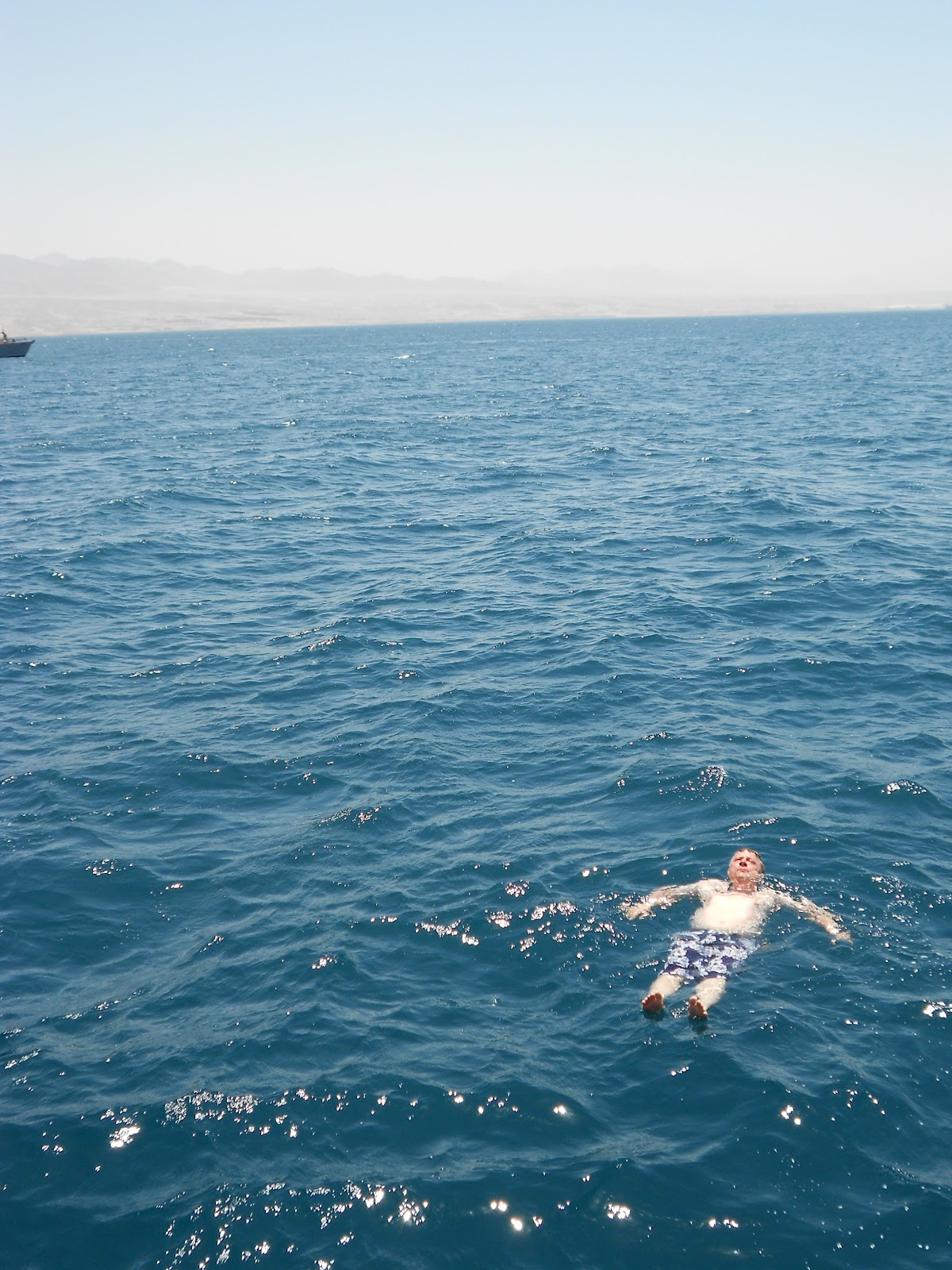
 After the visit to Masada, it was time to go to our Dead Sea hotel, which was nearby.  We couldn't wait to float in the Dead Sea... we had heard how much fun it was!  The extreme mineral content makes you float like a cork.  Some of us even had trouble getting back onto our feet again!  It was a perfect way to end a day that had a high temp of 96 degrees.


Laundry dries fast in 96 degree heat and 11% humidity!


Salt, not ice...


As we were settling down for the night, I heard a VERY LOUD noise, so I rushed to my window to see very loud and very fast jets flying up the Dead Sea.  The next day, our tour leader told me that the IDF does that all the time, just to let the enemies of their state know that they are there - a warning of sorts. That night, I also noticed a HUGE bonfire at a neighboring hotel.  I thought that was odd - seeing as the temps were still in the 90s after sundown - until someone told me the next day that it was a Lag b'Omer bonfire.


Thursday, June 21, 2012

Israel Day 5

The only thing we did today was visit Petra.  But it was a long, full day, and well worth it.  I took about five thousand photos... so how do I narrow them down?

Our tour guide, Tito, had to stay in Israel, because Jordan does not receive Israelis very well (and Jews are not permitted to live in Jordan.  Ironic, given the number of Arabs living in Israel as Israeli citizens is about a million and a half... but that is for a future post).  So anyway, our Jordanian tour guide was Michel, and he did a great job.


At the border


Petra "guards"

Michel insisted that God left a map of Petra in the rocks


Petra is basically a giant burial ground


The rock formations are awesome!
One of the horse and cart dudes

Man and his grandsons making music

Down in the heart of Petra

Indiana Jones movie, anyone?


At a roadside park, overlooking the mountains of Petra in the background
Back at the hotel, I was exhausted and went straight to bed!


Tuesday, June 19, 2012

Israel Day 4


I woke up after a full-night's sleep (finally!).  Today was busy but with fewer events.  We awoke at the crack of dawn in order to get to Haifa in time for our 8 am flight.

Dawn breaking over the Sea of Galilee

Our flight took us from the very northern city of Haifa all the way across Israel to the very southernmost city of Eilat.  What would have been a six-hour drive was flown in about 45 minutes, and what a beautiful flight!


Cesaerea from the air (can you see the aqueduct?)


Tel Aviv from above

The West Bank from the air (including the wall)

Shore of the Dead Sea

Colors of the Negev

We landed in Eilat and proceeded to an awaiting tourist boat for a sail on the Red Sea.  The Red Sea is very blue.  How did it get its name?  It is also called the Sea of Edom.  Edom is another name for Esau, and it means red.  Esau was red and hairy, remember?

Ready to go to sea!

Our hotel and the Egyptian border


"Swim with the Dolphins" beach in Eilat
It was a great day for a sunburn.  That sun was HOT!


Monday, June 18, 2012

Israel Day 3

Day three, and I had yet another night of no sleep.  I don't get it... falling asleep usually isn't a problem for me.  Yet on day three, I still had trememdous energy all day, which is good because it was another busy day with tons to see.

First thing in the morning, we boarded a boat on the Sea of Galilee.  The boat took us to the north end of the sea and dropped us off in Capernaum.  The boat ride was really cool!  The captain did a fishing net demo - see picture below.  Did you know that tilapia is indigenous to the Sea of Galilee and is also called St. Peter's fish?  Also, when Jesus told his disciples that a city on a hill could not be hidden, he was standing in full view of Safed, the highest city in Israel.

Safed - Highest city in Israel (City on a Hill)
Net casting demo


Approaching Capernaum


Synagogue made with white stone


Our bus met us after a tour of the excavated Capernaum, and we headed up the Golan Heights toward Mt. Hermon, Lebanon, and Syria.  One of my favorite spots of the entire trip was Cesaerea Philippi.  Located at the base of Mt. Hermon on the Israel side, there was a former pagan worship grove there, called Paneus (today, Baniyas).  There is a giant cave on the site that was known as "The Gates of Hades."  This is where Jesus and His disciples were when Peter declared Jesus to be the Messiah.  When Jesus said that the Gates of Hades would not prevail against His church, he was sitting by this cave!  Seriously, I felt like I was in a Ray Vanderlaan DVD.

The Gates of Hades
This area is also the source of the Jordan River. Fresh springs of living water flow down from the mountain and into the Sea of Galilee.  This water was crystal clear... I refilled my water bottle and enjoyed it tremendously!
Source of the Jordan

After visiting this fabulous area, our tour continued along the Golan Heights near Mt. Hermon (we were within two miles of Lebanon and the Hezbollah), where we were then able to stop and view the border with Syria.  The Golan Heights was acquired by Israel after the six day war of 1967, and then almost lost when Syria and Egypt attacked Israel on Yom Kippur 1973 (the holiest day of the year for Israel).  The tiny remnant of IDF soldiers were able to stave off the huge number of attacking Syrians until backup could arrive 24 hours later.  Ninety percent of those soldiers lost their lives in this battle. 

It is imperative that Israel maintain possession of the Golan Heights, for national security.  Losing the Golan would result in indefensible borders and also losing control of the water supply, which could be diverted by the enemies of Israel.

UN Peacekeeping camp at the Syrian border

IDF station, high on a hill overlooking the border

Beautiful Mt. Hermon in the distance
Evidence of earlier battles dot the landscape of Golan
After our Golan tour, we continued our touring day on the supposed Mount of Beatitudes, where of course a large Catholic church had been built.


Our last stop was a museum, called the Ancient Galilee Boat Museum, that featured a boat that was discovered buried in the sands of the Sea of Galilee a few years ago when the water level was very low.  The boat has been identified as being approximately 2000 years old.
The Boat
The Boat Mystery

Back at the hotel, we learned that a huge celebration was about to begin in Tiberias - right outside our hotel - for the Rabbinic festival of Lag b'Omer.  We took a walk along the streets of Tiberias, among thousands of Jewish people who came to commemorate the death of Rabbi Simon Bar Yochai, who is one of the founders of modern Rabbinic Judaism and Kabbalah (Jewish mysticism).  It is a custom for orthodox Jewish families to bring their three-year-old sons to the tomb of Rabbi Shimon for their first haircuts.  Children gather wood for weeks, in order to have humongous bonfires to commemorate the annual festival.

Lag b'Omer Parade
In the streets of Tiberias

By the way, Lag b'Omer means the 33rd day of counting the omer, which takes place from the Feast of Firstfruits until the day of Shavuot (or in Christianese - From Ressurection Sunday to Pentecost).