Tuesday, June 10, 2014

Watchmen on the Walls

I just returned from my third trip to the place where the Lord God has chosen to put His name - Jerusalem.

At the beginning of the trip, I asked Him for eyes like the servant of Elisha - to be given a glimpse into the heavenlies and the spiritual warfare going on over His holy city.  Then I waited and watched.

Throughout this trip, we were interceding for Israel - through prayer, worship, dance, and supporting our friends here.

We were blessed to be here for the day they celebrate called Shavuot. Biblically,  this is one of the three pilgrimage feasts required in the Levitical law.  

For the Jewish people, it is a grand celebration of the giving of the Torah on Mount Sinai. Many stay up all night studying Torah,  and the celebration continues all day. [Believers in Yeshua commemorate the giving of the Holy Spirit on this same appointed day of Shavuot, aka Pentecost, as recorded in Acts 2].  As the festival drew to a close, we joined the thousands of worshippers at the Kotel, or Western Wall. They were dressed in their best and had come to the Wall to pray.

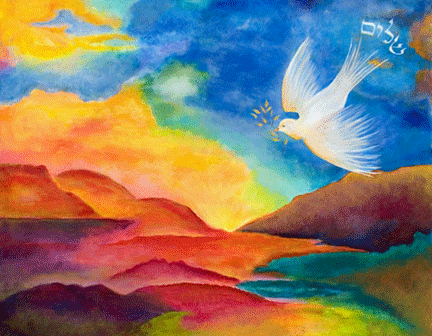
As I was praying for the Holy Spirit and the revelation of Yeshua to fall on these chosen people, God drew my attention to two groups of birds at the Wall.

On the right side of the wall where I was, in the women's section,  four doves were nestled in between the stones, keeping watch. The stalwart doves did not move the entire time I was there. They silently kept watch.


Meanwhile, to the left, a loud contingent of noisy birds made a ruckus. They appeared to be causing trouble as they swooped back and forth to the wall, screeching loudly, darting and disappearing like cockroaches into small openings between the stones.

At first I thought they were bats, but a team member told me they were barn swallows. Loud little buggers.
I was in awe as I watched the picture of spiritual warfare going on right in front of me.  (The dove is a symbol of the Holy Spirit.)

Several nights later, we came again to the Kotel to pray.  The doves were still faithfully keeping watch in their places, unmoving and stalwart.  The loud, angry birds from the previous night were nowhere to be seen.  What a picture of God's steadfast watch over His chosen people, as He waits for His perfect timing to reveal Himself to them.  Meanwhile, the enemy noisily plots and schemes against them, all in vain.

 The Lord did not answer my prayer in the way I had asked Him.  Instead of giving me a glimpse into the spirit world, He chose to use the natural world to answer my prayer.  I know that the picture in the heavenlies is much bigger, but God in His mercy gave me what He knew I could handle.

Wednesday, March 26, 2014

God's Manifest Presence

This was not written by me, but was a devotional I came across this past week from a ministry in Israel.  The devotional was written with the weekly Torah portion in mind, from Leviticus 9.


Manifestation of God’s Presence: Aaron Begins His Ministry
 
“This is what the Lord has commanded you to do, so that the glory of the Lord may appear to you.”  (Leviticus 9:6)
 
On the eighth day, the day following an entire week of purification, Aaron and his sons began their ministry by offering the required sin offering, burnt offering and fellowship offering.
 
After Aaron had done all that the Lord had commanded through Moses, he stretched out his hands and blessed the people before stepping down from the altar.
 
But the people were not only blessed once.  Moses and Aaron blessed them again after they returned from the Tent of Meeting.  At this, the fire of God came upon the offerings and consumed them.
 
“Then Moses and Aaron entered the Tent of Meeting, and when they came out, they once again blessed the people.  Then fire issued from the presence of the Lord and consumed the burnt offerings and the fat portions on the altar.”  (Leviticus 9:23–24)
 
With this remarkable manifestation of the Glory of God, the people felt such an awesome experience of being in the presence of the Lord that they shouted for joy and even fell down on their faces!

Sadly, this incredible time of worship was followed by sorrow because of a tragic incident in which fire from the presence of God also came in judgment.
 
The sons of Aaron, Nadab and Abihu, who had just a short while earlier been instructed on the Temple service, changed the pattern of worship given to them by God through Moses.
 
In perhaps a grandiose, irreverent or drunken display of their ministration before the people, they offered unauthorized fire before the Lord (maybe offering incense at the wrong time) and, therefore, they perished:
 
“So fire came out from the presence of the Lord and consumed them, and they died before the Lord.”  (Leviticus 10:2)
 
After reading about the spectacular event of God's fire consuming the offering and other miraculous, supernatural events in the Bible, some of us long for a dramatic manifestation of the Shekhinah glory of Adonai; however, we must keep in mind that the experience of the Israelites at this time was out of the ordinary.  


The fire of God did not consume the offering on a daily basis.  The people continued their worship, sacrifices, and offerings even when they did not “feel” anything special and nothing exceptional happened.
 
Likewise, our spiritual life should not be a pursuit of supernatural, dazzling encounters; neither should we think something is amiss in our relationship with the Lord if we are not continually riding an emotional “high.”
 
Just as a marriage relationship should not require continual thrills to stay committed, so should our hearts remain steadfast in our relationship with the Lord even when there seems to be no fresh fire.


 [This is not to say that the Lord will not give us supernatural manifestations today.  He can and He does, according to His sovereign will and purposes]

Wednesday, March 19, 2014

Under the Fig Tree

I learned something today that suddenly clarified a passage of scripture for me.  I love it when the understanding of a Jewish idiom can make the light bulb go on.

The passage comes from John 1, as Yeshua was building his team of disciples, beginning with verse 43:

On the next day Jesus wanted to set out for Galilee. He found Philip and said to him, “Follow me.”  Now Philip was from Bethsaida, the town of Andrew and Peter. Philip found Nathanael and told him, “We have found the one Moses wrote about in the law, and the prophets also wrote about—Jesus of Nazareth, the son of Joseph.” 

Nathanael replied, “Can anything good come out of Nazareth?” Philip replied, "Come and see.”

Jesus saw Nathanael coming toward him and exclaimed, “Look, a true Israelite in whom there is no deceit!” 

Nathanael asked him, “How do you know me?” Jesus replied, “Before Philip called you, when you were under the fig tree, I saw you.” Nathanael answered him, “Rabbi, you are the Son of God; you are the king of Israel!”

What is going on here?  Obviously, there is something in this dialogue that gives Nathanael a major "aha" moment that Yeshua is the Messiah.  But a surface reading does not really tell us why.  Also, it seems like Yeshua is saying that Nathanael is the righteous one.

Here is a Jewish Roots clue.  The term "under the fig tree" is an ancient Jewish idiom that means studying the messianic prophecies.  The idiom stems from Micah 4:4, in a passage describing the future messianic kingdomEach of them will sit under his vine, and under his fig tree.


Our first clue to the fact that Nathanael was a scholar of the messianic prophecies is his comment regarding Nazareth.  He knew that scripture clearly taught that the Messiah would be born in Bethlehem, but wasn't so sure about the Nazareth connection.

[The prophecy regarding Nazareth is a bit more hidden (Isaiah 11:1 speaks of the branch, which is netzer in Hebrew, and the town of Nazareth, (netzret in Hebrew), means "branch town").]

When Yeshua first spoke to Nathanael, He was referencing the second part of Isaiah 53:9:
Because He had done no violence,
Nor was any deceit in His mouth.


Yeshua was not calling Nathanael righteous. Yeshua was quoting the very prophecy that Nathanael had been studying, in order to emphasize that He Himself was the Messiah.

This is why Nathanael responds with Hey, how in the world did you know that about me??

Yeshua then further confirmed that He knew Nathanael was a studier of the messianic prophecies when He said He saw Nathanael "under the fig tree."

Of course, Nathanael knew that only the Messiah could know that about Him without being told, which is why he acknowledged Yeshua as the Messiah:  Son of God and King of Israel.

Sunday, February 16, 2014

The Seven Covenants


Have you ever seen someone shrug and say, "well, that's Old Testament" when discussing the Bible?  I know I have heard that many, many times.

The holy scriptures are usually thought of by most Christians as Old Testament and New Testament.  And many people separate them in their minds, considering the "old" to be obsolete.

But did you know that the scriptures, from Genesis to Revelation, tell one complete story?  That Yeshua did NOT come to Earth to create a new religion called Christianity?  That He is the fulfillment of all that was foreshadowed about Him in the Hebrew scriptures, from the very first book?

There is a saying that goes like this:  "The Old Testament is the New Testament concealed, and the New Testament is the Old Testament revealed."

So many people, who have been taught Replacement Theology (which teaches that the church has replaced Israel in God's kingdom) believe that God is done with Israel because they were disobedient, so therefore all the blessings promised to THEM are now given to the church.  And the Word does say that Israel was kicked out of the land (twice) because of their disobedience.  How do we reconcile this?

Easy.  There is more than just "one old covenant, one new covenant" in the scriptures.

The scriptures actually record SEVEN covenants that the Lord YHVH initiates with man.  Like many other things in scripture that are featured in groupings of seven, the seven covenants reveal a complete picture.  The word for seven in Hebrew, sheva, means complete.  (For quite awhile, I could only find five covenants between God and man, but deep down, I was convinced that there were seven.  As I continued to study the Word, YHVH, blessed be He, showed me the other two).

The Hebrew word for covenant is b'rit.  The meaning of the word is to make a treaty, or alliance with someone, carrying with it the idea of cutting.  Blood was usually shed when a covenant was cut.

(As a kid, did you ever make a pact or become someone's blood brother or sister through cuts in your fingers?  Same idea.)

Let's look at the Biblical seven covenants that YHVH instituted with mankind.

1.  Eden
After Adam and Eve's disobedience brought sin into the world, the Lord God promised a redeemer, and that He would be the Seed of the woman in Genesis 3:15  (Notice that God did not say seed of the man.  This is our first clue that the Redeemer would not have an earthly father.  Nor did it say seeds, thus showing that there would only be one Redeemer).  God then provided animal skins as a covering for them, after they had tried to cover themselves with fig leaves - their own works - which were not acceptable.  Blood had to be shed for proper covering.  This covenant would be fulfilled by the Messiah at His first coming.


2.  Noah
Adam and Eve were forced from the garden so that they would not eat from the Tree of Life and live forever in their fallen state.  The world became a wicked, wicked place.  So wicked in fact, that God chose eight people with whom to start over, and then flooded the entire Earth.  Upon disembarking, Noah sacrificed clean animals to the Lord God, and God added meat to man's diet.  He then sent the rainbow as a sign of His covenant never to destroy the Earth with water again.  This is an everlasting promise.  (Someday, however, the earth will be destroyed with fire and regenerated.)


3.  Abraham
Ah, the Abrahamic covenant.  Probably the most misunderstood by many people.  YHVH made a covenant that was permanent and unconditional.  The covenant included the Land (Israel), the Seed (Yeshua), and the Blessing (Salvation to the nations), according to Genesis 12:1-3.


Genesis 15 and 17 give us further insight to the covenant details.   Genesis 17:7 assures us that the covenant is for good:  And I will establish My covenant between Me and you and your descendants after you in their generations, for an everlasting covenant, to be God to you and your descendants after you.  (I just want to interject here that if God can revoke His promises to Israel because of disobedience, then we are all toast).  The covenant was repeated to Isaac (Genesis 26) and to Jacob (aka Israel, Genesis 28), clearly demonstrating that the covenant was for Israel.


4.  Moses
YHVH continues His plan with mankind by instituting a covenant with Moses at Sinai.  The purpose of this covenant and its commandments (mitzvot) was to demonstrate man's complete inability to atone for himself, and to point to a future Redeemer who would one day perfectly keep every precept of the covenant.  Jeremiah 31:31-32 tells us about this future new covenant:  “Behold, the days are coming, says the Lord, when I will make a new covenant with the house of Israel and with the house of Judah— not according to the covenant that I made with their fathers in the day that I took them by the hand to lead them out of the land of Egypt (in other words, the Sinai/Moses covenant would be fulfilled by a future covenant.  Nothing is said about the everlasting Abrahamic covenant).


5.  David
This one sort of sneaks up on us, and was one that I was unaware of until recently. But one day as I was reading 2 Samuel 7, I realized that YHVH had just made another covenant, this time with King David.   David wanted to build a permanent home for YHVH, even though YHVH had not commanded David to do it.  So God actually promised DAVID a house in verse 11 - Also the Lord tells you that He will make you a house.  Scripture goes on to say “When your days are fulfilled and you rest with your fathers, I will set up your seed after you, who will come from your body, and I will establish his kingdom.  He shall build a house for My name, and I will establish the throne of his kingdom forever.  Of course, this is another promise of the coming Messiah, who would carry on the line of King David forever.


6.  Yeshua
At a Passover Seder with His disciples, Yeshua said this in Matthew 26:28: For this is My blood of the new covenant, which is shed for many for the remission of sins.   Luke 22 records that this was the cup taken right after dinner.  In the traditional Passover Seder (order), there are four cups of wine to drink; two before dinner and two after dinner.  The cup right after dinner, the third cup, is called the Cup of Redemption.  Before Passover ended, Yeshua fulfilled this by shedding His blood and dying (at the very same moment the national symbolic lamb was slaughtered at the temple).  Even though He obeyed every single precept of the Moses covenant perfectly and was therefore not under the death penalty (see Romans 6:23), He willingly gave up His life for us; thus fulfilling the promise of the new covenant in Jeremiah 31:31.


7.  Covenant of Peace
For the most part, the nation of Israel rejected the new covenant (even though the early believers were ALL Jewish), so that God in His sovereignty could offer the good news of redemption to the rest of the world.  However, because of the Abrahamic covenant, God HAS to keep His promise to Israel (or else He would be a liar).  In the last days, the nation of Israel will recognize Yeshua as their Messiah according to Romans 11:25, Zechariah 12:10, Isaiah 54:8, and other places.  The seventh covenant occurs when Yeshua returns and Israel once again is restored to YHVH.

Look at these promises He made to Israel, which have yet to be fulfilled:

“I will make a covenant of peace with them, and cause wild beasts to cease from the land; and they will dwell safely in the wilderness and sleep in the woods.   - Ezekiel 34:25

Moreover I will make a covenant of peace with them, and it shall be an everlasting covenant with them; I will establish them and multiply them, and I will set My sanctuary in their midst forevermore. - Ezekiel 37:26

For the mountains shall depart
And the hills be removed,
But My kindness shall not depart from you,
Nor shall My covenant of peace be removed,”
Says the Lord, who has mercy on you. - Isaiah 54:10


Saturday, January 25, 2014

Who is my Neighbor?

I love the continuity of scripture.

The parable of the Good Samaritan in Luke 10 follows on the heels of the seventy disciples returning from their Yeshua-given mission, filled with joy at all they had seen.

Yeshua then rejoiced that God had hidden kingdom mysteries from the wise, and revealed them to simple babes (the disciples - who were ordinary men, not scholars).  Proverbs 30 shows the great desire of wise men to know God’s mysteries:  Agur asks beseechingly,
Who has ascended into heaven, or descended?
Who has gathered the wind in His fists?
Who has bound the waters in a garment?
Who has established all the ends of the earth?
What is His name, and what is His Son’s name,
If you know??

As we head into the parable of the Good Samaritan, the narrative now jumps to the other side.  Enter the expert in the law.  The "wise one." 

In Luke 10:25, this teacher of the law asks Yeshua what HE needs to do to inherit eternal life.  (In other words, he is asking how he can work his way to justification).

Yeshua, in typical Hebrew fashion, asks him a question… What is written in the law... how do you see it?

The law expert gives the two greatest commandments - love the Lord your God with all you've got, and love your neighbor as yourself.

Jesus says yep.  And then He waits.

The law expert continues.  Wanting to justify himself, he presses on and asks who constitutes his neighbor.

I need to pause here for a moment and describe what is behind that question.  This question had been debated by the Jewish teachers of the law ever since the command had been given on Mt. Sinai.  Who exactly is my neighbor?

Leviticus 19:16-18 says, You shall not go about as a talebearer among your people; nor shall you take a stand against the life of your neighbor: I am the Lord. ‘You shall not hate your brother in your heart. You shall surely rebuke your neighbor, and not bear sin because of him. You shall not take vengeance, nor bear any grudge against the children of your people, but you shall love your neighbor as yourself: I am the Lord.

The context of neighbor in the Torah is one’s fellow Israelite.  The man wanted to know if he had to love all the Jewish people, or just the ones in his circle.  The ultra-orthodox?  The Hellenized?  He would not have even remotely meant a Gentile, and especially not a Samaritan. 

The Torah is about to be amplified.  The Messiah is preparing them for the change in the law. 

The progression of Priest - Levite - common man was a typical Hebraic form of thought.  For example, the order of reading from the Torah would have been priest, then Levite, then the common man.  However, Yeshua changed the third character to a Samaritan!  He also changed the law expert's question at the end of the story.  Not who is my neighbor, but which one acted like a neighbor?

The law expert couldn’t even bring himself to say the word Samaritan, but grudgingly said the one who had mercy.  (It reminds me of the way many Arabs today cannot bring themselves to say Israel, but instead say that Zionist state).

Under the surface, we find a picture of Yeshua and the Body of Messiah in this parable.

Yeshua is the good Samaritan; the only one able to show unconditional love, in spite of rejection.  The Samaritan is highly rejected by the Jews, and Yeshua is also the stone that the builders (such as the law expert) rejected.

The Jericho Road was a rough place.  Even today, one can picture how it might have been thousands of years ago.  The route ascends 4000 feet going up from the Dead Sea to Jerusalem.  It is dotted with Bedouin tents, some of whom are descendents of robbers that used to lay in wait for pilgrims on their way to Jerusalem.


The Jericho Road is our life.  It’s tough.  We are the ones laying at the side of the road of life, and this road beats us up.  There are robbers and a lot of things on the road of life that cause the hurts.  We lay there beaten, robbed, naked, and half dead, and we need the Merciful One.

What does Yeshua do?  First, He binds up our wounds (He binds up the brokenhearted – see Isaiah 61:1, Psalm 147:3, Luke 4:18).    He then pours oil on us (which represents the Holy Spirit).  Isn't that a wonderful picture?  He takes care of our wounds, but He doesn’t stop there… then He pours out His spirit on our lives.  The third thing applied to our wounds is wine.  Wine represents joy!!  Joy that comes from the Holy Spirit.

This is what the Merciful One does when He finds us.


Then, just like the Good Samaritan, He puts us on His beast of burden so we don’t have to walk.  In this way, He carries our burdens.

The wounded man is taken to the inn, which represents the Body of Messiah, the congregation, the church.  He gives the innkeeper 2 denarii and then departs, promising to come back.  (Each denarii represents a days wages…. and in Hebraic thought, a day projects to one thousand years.   2 Peter 3:8 confirms this:  But, beloved, do not forget this one thing, that with the Lord one day is as a thousand years, and a thousand years as one day.)

In this way, He gives us what we need to minister at the inn, and then He departs for two thousand years.  He brings the wounded person into the care of the congregation, and says, “When I return, I will reimburse you for any expense.”  The reimbursement is the rewards we earn for ministry in the Body of Messiah.

Jesus is preparing the disciples for New Covenant Law… we must love everyone, not just those in our own circles or nationality.  The symbolism in the priest and the Levite walking by represent the passing away of the Sinai covenant.  The priest and the Levite will no longer be able to help (and in fact, most were put to death in 70 AD when Jerusalem was sacked by Rome).   The book of Hebrews describes the new and better covenant 15 times.  The former law was all based on the system of the priesthood and Levites.

So, back to the law expert's question, "What must I do to inherit eternal life?"  There are no works which will qualify us. We must have the Merciful One find us on the road of life.

Welcome to the Inn!


Sunday, January 12, 2014

The Church as a Midwife

We owe a huge debt to Israel.

Without the Jews, we would have no covenants, no prophets, no apostles, no Bible, and no Messiah!  Yeshua Himself declared in John 4:22, "Salvation is of the Jews."

But God's plan was not only for the Jews.  They were His starting point, to be a light to the nations.  But they are also going to be His ending point as well.  Romans 11 tells us that it was for our benefit (the Gentiles) that the natural branches (Israel) were blinded in part, so that salvation could go out to the rest of the world, and then the nation of Israel would be saved.  We are also warned in Romans 11 not to be arrogant toward those natural branches.

Sadly, church history shows that the opposite happened.

Replacement Theology arose in the second century among the early church fathers.  This theology (wrongfully) teaches that God is done with the Jews for good, and that all blessings and promises have been transferred to the church.  Perhaps these church fathers were well-meaning; after all, the Jews had been kicked out of the Holy Land with no prospect of ever returning.  That would take a miracle!

However, this dangerous theology has led to the death of millions of Jews throughout the 19 centuries of their exile.  There has been persecution, pogroms, expulsions, the Crusades, blood libel accusations, forced conversions, accusations toward the Jews of deicide (aka "Christ killers"), the Spanish Inquisition, and the Holocaust, all too often perpetuated in the name of the Jewish Messiah.

This theology also continues today in many (if not most) mainline denominations, in spite of the totally miraculous return of the Jews to their Promised Land.  Whoa!  Talk about messing with one's theology!  This explains why so many Christians today are actually AGAINST the rebirth of the nation of Israel - treating it as a renegade nation instead of the fulfillment of God's promise, thousands of years ago, to Abraham, Isaac, and Jacob.

But God has given the church a very special role to play in these last days.  We actually get to be the midwife for Israel's spiritual rebirth - forerunners, so to speak.  Intercessors.  What a privilege!  There are four things that Scripture calls us to do.  (He who has ears to hear, let him hear!)

**Update!  Four years later, I realize that I forgot one.  So make that five ways!

#1 - Bless Israel
Genesis 12:1-3 says, Now the Lord had said to Abram:  “Get out of your country,
From your family
And from your father’s house,
To a land that I will show you.
I will make you a great nation;
I will bless you
And make your name great;
And you shall be a blessing.
I will bless those who bless you,
And I will curse him who curses you;
And in you all the families of the earth shall be blessed.”


This promise was repeated to Isaac in Genesis 26 and Jacob in Genesis 28.  This promise to Israel, regarding the Land, the Seed, and the Blessing, is the Abrahamic covenant.  It is everlasting and was never rescinded.

Notice the promise of blessing to those who bless God's people.  Scripture also gives us warnings if we neglect to bless them.  There are two words used for curse in the above reference.  The second word for curse actually means to lightly esteem, or to treat as unimportant.

Zechariah 2:8-9 says, For thus says the Lord of hosts: “He sent Me after glory, to the nations which plunder you; for he who touches you touches the apple of His eye. For surely I will shake My hand against them, and they shall become spoil for their servants. Then you will know that the Lord of hosts has sent Me.

#2 - Comfort Israel

Isaiah 40:1-2 says
Comfort, yes, comfort My people!”
Says your God.  (Think of the pronouns used here... comfort MY people says YOUR God)
 “Speak comfort to Jerusalem, and cry out to her,
That her warfare is ended,
That her iniquity is pardoned;
For she has received from the Lord’s hand
Double for all her sins.”


Matt 25:37-40, in the context of the last days, says “Then the righteous will answer Him, saying, ‘Lord, when did we see You hungry and feed You, or thirsty and give You drink?  When did we see You a stranger and take You in, or naked and clothe You? 39 Or when did we see You sick, or in prison, and come to You?’  And the King will answer and say to them, ‘Assuredly, I say to you, inasmuch as you did it to one of the least of these My brethren, you did it to Me.’  (The Greek word for brethren literally means relatives or close kinsmen).


#3 - Make Israel Envious

Deuteronomy 32:21 (repeated in Romans 10:19) says,
But I will provoke them to jealousy by those who are not a nation;
I will move them to anger by a foolish nation.

Romans 11:11 - I say then, have they stumbled that they should fall? Certainly not! But through their fall, to provoke them to jealousy, salvation has come to the Gentiles.

Romans 11:14 (Paul is speaking here) if by any means I may provoke to jealousy those who are my flesh and save some of them.


#4 - Intercede for Israel:

Psalm 122:6 says –  Pray for the peace of Jerusalem:
“May they prosper who love you.
  (Another scripture with a promise!)

Is 62:6-7 - I have set watchmen on your walls, O Jerusalem;
They shall never hold their peace day or night.
You who make mention of the Lord, do not keep silent,
And give Him no rest till He establishes
And till He makes Jerusalem a praise in the earth.


And just who are these watchmen?  It's you who make mention of the LORD.  Do YOU make mention of the LORD?  Are you His follower?  If so, He's talking to you.  You must not keep silent!


**Here it is, the missing fifth directive in regard to our treatment of Israel.


#5 - Support Israel
Acts 11:27-29
And in these days prophets came from Jerusalem to Antioch. Then one of them, named Agabus, stood up and showed by the Spirit that there was going to be a great famine throughout all the world, which also happened in the days of Claudius Caesar. Then the disciples, each according to his ability, determined to send relief to the brethren dwelling in Judea.

Romans 14:27
For if the Gentiles have shared in the Jews’ spiritual blessings, they (us) owe it to the Jews to share with them their material blessings

Romans 15:25-27
But now I am going to Jerusalem to minister to the saints. For it pleased those from Macedonia and Achaia to make a certain contribution for the poor among the saints who are in Jerusalem. It pleased them indeed, and they are their debtors. For if the Gentiles have been partakers of their spiritual things, their duty is also to minister to them in material things.

1 Cor 16:1-3
Now concerning the collection for the saints, as I have given orders to the churches of Galatia, so you must do also: On the first day of the week let each one of you lay something aside, storing up as he may prosper, that there be no collections when I come. And when I come, whomever you approve by your letters I will send to bear your gift to Jerusalem.


Wednesday, December 25, 2013

God Will Provide Himself a Lamb

Today I was meditating on the akedah, the time when Elohim tested Abraham and asked him to sacrifice his beloved son Isaac. His specific instructions in Genesis 22:2 are this:  “Take now your son, your only son Isaac, whom you love, and go to the land of Moriah, and offer him there as a burnt offering on one of the mountains of which I shall tell you.”

What??  This was Abraham's long awaited, miraculous son!  How could God ask that of him??  But look at the faith that Abraham displayed when Isaac wanted to know what was going on:

Genesis 22:8 says, And Abraham said, “My son, God will provide for Himself the lamb (Hebrew seh) for a burnt offering.” So the two of them went together.

We know the story.

Abraham passed the test, and Elohim stayed His hand.

Genesis 22:13 says, Then Abraham lifted his eyes and looked, and there behind him was a ram (Hebrew ayil) caught in a thicket by its horns. So Abraham went and took the ram, and offered it up for a burnt offering instead of his son. 


What happened to the lamb that Abraham prophesied?  Lambs and rams are not quite the same thing.

God provided Himself - the Lamb - about 1000 years later, who was sacrificed on the very same mountain where Abraham passed the test.

John 3:16 is a fulfillment of the shadow that was cast in Genesis 22:2...  For God so loved the world that He gave His only begotten Son, that whoever believes in Him should not perish but have everlasting life.