Wednesday, June 10, 2015

God Answers!

I serve a faithful God.

I have been feeling a little dry spiritually, so yesterday, I took a prayer walk.  During my time with the Almighty, I asked Him to give my kids a kingdom spark.  A faith boost.  More motivation to seek Him and less motivation to pursue the world's distractions.

A few hours later, I noticed that my daughter had made a comment on social media about the goodness of God.  This was followed by an excited comment by my son, agreeing with her wholeheartedly.

Here is what happened.

My daughter was on her break at work.  She happened to strike up a conversation with an Asian woman who turned out to be a missionary from the Philippines.  My daughter was very blessed and encouraged by the conversation, and proceeded to give a $20 donation to the missionary.  The lady accepted the donation gratefully and offered my daughter a handmade bracelet.


After work, my daughter went over to my son's place of work and told him what happened.  His eyes got as big as saucers, and he proceeded to tell her what happened to him that day.

A missionary from Thailand had stopped by his work and had a conversation with him.  He told her he was blessed by the conversation, and offered her a donation of $20.  She accepted the donation gratefully, and proceeded to offer him a handmade necklace.

Sometimes God answers prayers immediately.  Other times, He asks us to wait.  This was an example of an immediate answer.

A reminder of God's faithfulness
At the end of the day, both kids came home with more than a spark for the Kingdom.  My daughter is even more excited about her upcoming mission trip and prayer internship, and my son is now making active plans to pursue missionary training.

Coincidence?  I think not.


Saturday, May 30, 2015

Musings on the Crucifixion, Part 2

If you missed part one, you can click here to read it.

Tradition says that Yeshua was crucified at the site of the Church of the Holy Sepulchre, which was "discovered" by Constantine's mother Helen through a series of "visions" in the fourth century. It is a very, ahem, interesting place, and perhaps some day I will write a post on it.  Or not.  Suffice it to say that the location of the site had formerly housed a temple of Venus, and that seven different sects of Christianity spar with each other over the rights to the place.  Ironically, the key is held by a Muslim family.  It is located to the north and the west of Mount Moriah.


Another location that claims the site of the crucifixion is the Garden Tomb, located on the north side of the city, just outside the Damascus Gate. A beautiful and peaceful place, to be sure, and a great place to meditate on what Yeshua did for us.


However, there is really no scriptural pattern that would justify a site to the north or the west of the Temple Mount.

For a few years now, I have believed that the crucifixion took place on the Mount of Olives, east of the Temple Mount across the Kidron Valley.  Knowing some of the Jewish roots of our faith is very helpful here.

In scripture, the idea of movement toward the east signifies cursing, and movement toward the west indicates blessing.  This pattern is demonstrated over and over again.  The Garden of Eden was probably on Mount Moriah.

Every single translation that I can find of Genesis 2:8 says that God planted a garden Eastward, or toward the East.  However, this is incorrect.  The Hebrew word kedem (which means both east and from ancient times) is preceded by the Hebrew letter mem, means from.  God either planted a garden from the earliest times, or from the East (or both).  But not toward the east.

Here are just a few examples of God's pattern of eastward being the direction of cursing, and westward being the direction of blessing:
  • Adam and Eve were kicked out of the garden, toward the east.  
  • When the Jews were dispersed from Jerusalem to Babylon, they went east.  The regathering was toward the west.  
  • When the glory of the Lord departed from the temple in Ezekiel 11, it went east.  
  • In Yeshua, our sins are removed as far as the east is from the west.  (Side note:  If you head north long enough, eventually you will go south.  Not so with east and west).  
  • The gospel began in Jerusalem and has made its way, for the most part, in a westward movement and is now heading back westward across the 10/40 Window where it will culminate in Jerusalem.  
  • When Yeshua returns, He will descend onto the Mount of Olives and head west, into the city of Jerusalem.  
  • Even the sun works its way across our sky in an east to west direction.


Abraham took his son Isaac to the land of Moriah, as directed by God.  God then showed him exactly the place where the eventually-averted sacrifice of Isaac was to take place.  Methinks God led them to the Mount of Olives, east of the location of the future temple, and probably the exact place were Yeshua was crucified.

Kidron Valley, Mount of Olives in the distance
When Yeshua took on the curse of sin, this established pattern from God indicates that the crucifixion would be to the east of the Temple Mount, which would put it across the Kidron Valley and on the Mount of Olives.

Deuteronomy 21:22-23 tells us, If a man has committed a sin deserving of death, and he is put to death, and you hang him on a tree, his body shall not remain overnight on the tree, but you shall surely bury him that day, so that you do not defile the land which the Lord your God is giving you as an inheritance; for he who is hanged is accursed of God.

That's not all.  There is biblical evidence that He was nailed to a living tree, and that the two robbers were on the same tree; one on each side of Him.  And it was likely an almond tree, and the Tree of Life in the Garden of Eden was probably an almond tree.  (I know... this flies in the face of every depiction of the crucifixion we have ever seen).  The menorah in the temple was fashioned after an almond tree.  With Yeshua in the middle between the two criminals, all arms raised, they would have resembled a menorah.  The six branches of the menorah represent mankind with the seventh middle branch representing God.  If this is the case, what a stunning picture of Yeshua - Son of Man and Son of God - in the middle, featuring the head of God with human arms raised up.


There is yet another picture to consider in this scenario.  In the temple across the Kidron Valley, the Holy of Holies featured two cherubim on the Mercy Seat facing one another, covering the Ark of the Covenant (which housed the Ten Commandments, manna, and an almond rod).


The two criminals on the tree with Yeshua would have depicted just the opposite, facing away from Him.

My God, my God, why have you forsaken me?  Psalm 22:1

Even the very items contained in the Ark of the Coven:ant were highly symbolic.  The Almond Rod - a picture of the priesthood for Yeshua, our High Priest.  The manna, for Yeshua, our Bread of Life.  And the Ten Commandments, showing that Yeshua fulfilled every single precept of the Torah perfectly, thereby becoming our Living Torah when we put our faith and trust in Him.


Friday, May 15, 2015

Musings on the Crucifixion, Part 1

In the past few weeks, new insights have been introduced to me, from various sources, regarding the Jewish roots of the crucifixion.  So bear with me as I ponder these things here.

The first thing that has come up is the account of the rooster crowing at Peter's third denial.  Ancient writings show that chickens and roosters were not allowed in Jerusalem during Passover, because they were unclean.  (I have raised chickens and roosters and can very much attest that this is true).  

I then discovered that the term "crowing of the rooster" actually was a euphemism for the first and last blowings of the shofar each day by the priest at the temple.  When the priest blew that shofar early on that Passover day when Yeshua became our sacrificial Lamb, it was the last legitimate shofar blow of the priesthood.  Yeshua was about to fulfill the priesthood by becoming our High Priest.


One other verse of interest in this regard comes from Mark 14:51, a seemingly random and odd scripture:  Now a certain young man followed Him, having a linen cloth thrown around his naked body. And the young men laid hold of him, and he left the linen cloth and fled from them naked. 


 Linen was the garment of the priesthood.  In the same sense of the shofar, we can see in the stripping of the linen a picture of the priesthood coming to an end.

Moving on to the trial of Yeshua...

The people had a custom of having a prisoner released to them at Passover.  Pilate saw not fault in Yeshua and wanted Him to be that released prisoner.  However, the people demanded Barabbas.

Barabbas means "Son of the Father."

So you have two men, both of them the Son of the Father.  However, one was released, and one was killed.  In this respect, Yeshua the Messiah fulfilled not only the role of the Passover Lamb, but of the goat that was sacrificed by the priest at the Day of Atonement.  See these words from Leviticus 16:7-10:  
He shall take the two goats and present them before the Lord at the door of the tabernacle of meeting. Then Aaron shall cast lots for the two goats: one lot for the Lord and the other lot for the scapegoat. And Aaron shall bring the goat on which the Lord’s lot fell, and offer it as a sin offering. But the goat on which the lot fell to be the scapegoat shall be presented alive before the Lord, to make atonement upon it, and to let it go as the scapegoat into the wilderness.


Wow.  God's word is so precise... so many patterns are evident.  Yeshua the Messiah became the One to Whom the LORD's lot fell, and He was killed as a sin offering.  Barabbas became the scapegoat and was set free alive.

My next post will address several additional aspects of the crucifixion.


Sunday, March 22, 2015

The Servant, Faithful and Nameless

It has been said that all Biblical truth can be found in seed form in Genesis.  The more I study it, the more I find it to be true.

I write about Joseph a lot.  Much of his life was a foreshadow of Yeshua our Messiah.  But we can also look at the life of Joseph's grandfather, Isaac.  More beautiful parallels begin to emerge.

In Genesis 22, we see the binding of Isaac by Abraham.  For those of us who know Yeshua as our Redeemer, the similarities to Yeshua are pretty easy to spot.  Abraham was willing to sacrifice his beloved son Isaac, the Son of the Promise, out of obedience to the Lord God.  Happily, Yehovah stopped Abraham and provided a sacrificial ram instead.  This points to the ultimate sacrifice at the cross.


The Genesis story continues, but we don't hear anything more about Isaac until it was time for him to be married.  The obvious parallel is that after Yeshua was sacrificed and then rose, He returned to Heaven and will not return again until He comes back to claim His bride.

Let's look at the story, in Genesis 24, one of the most wonderful love stories in scripture.

We see Abraham, advanced in age, declaring that it was time for his son to be married.  In the same way, God Himself will one day declare the wedding day of His Son.  Abraham called on his old, nameless, and faithful servant, and gave him the task of going to find a wife for Isaac.  

Who was this guy?  The passage tells us that he ruled over all that Abraham had.  Could he be Eliezer from Damascus, mentioned in Genesis 15:2 as a faithful servant and potential heir of Abraham in the absence of children?  My guess is yes.  But I find it interesting that his name was only mentioned once, and then he faithfully does his work in the background, with no complaints that he didn't get to be the heir after all.

The faithful and obedient servant set out on the long journey to do his master's bidding, along with ten camels and probably a whole bunch of other stuff, in order to obtain the bride for Isaac.  Abundant gifts for the bride!!


When the servant arrived at his destination, he immediately asked the Lord for very specific signs.  Before he even finished speaking, the signs began to manifest, exactly as requested.  Hmm, so this unnamed servant had intercessory power and the ear of the Almighty.

The unnamed servant revealed Isaac to the potential bride.  In verse 34, just before he described his master's kingdom, he simply said, "I am Abraham's servant."  Not, "I am Eliezer, the most trusted, favored, and important servant of my master Abraham."

He went on to reveal to the bride and her family just how splendid his master's kingdom was.

What was this servant's purpose?  To lead the Bride to the Bridegroom.  To do the Father's will.  To be a faithful helper.  To deflect the glory to His Master.  To shower the Bride with gifts. To point to the Son.

He sounds a lot like the Holy Spirit.

And if that is the case, then it means that Isaac is a picture of Yeshua the Bridegroom, and Rebekah is a picture of you and me, the Bride.  What a love story!


Saturday, March 21, 2015

Happy New Year!

A recent email regarding this blog has alerted me to the fact that I haven't posted in awhile.  I had to say, the email caught me by surprise.  (Someone actually reads my rambling thoughts?  Wow!)

So I thought I would drop in and wish you a happy new year.  No, it is not belated; I refer to the new year that nobody celebrates - the Biblical one.


When Moses led the children of Israel out of Egypt and into the Promised Land, a new covenant was established between the Lord God and His people Israel - the Sinai, or Mosaic Covenant.  It included many precepts, which required obedience in order to stay in the land.  The sages have counted 613 of them!

The Jews refer to these precepts as Torah (a word derived from archery, meaning direction, shooting straight, hitting the mark, or teaching.  Personally, I refer to the entire scriptures from Genesis to Revelation as Torah... the whole counsel of teaching that comes from God.)

Obeying these Mosaic Covenant precepts gave Israel the right to live in the land that they already owned, according to the Abrahamic Covenant.  Disobedience would cause them to get temporarily kicked out of their land before being brought back for another chance.  Historically, this has happened twice.  We are currently in the middle of the second regathering to the land.

So what does all this have to do with the Biblical new year?  In Exodus 12, the very first thing God established with Israel when they left Egypt is the Passover.   Verses one and two tell us, The LORD said to Moses and Aaron in Egypt, “This month is to be for you the first month, the first month of your year."

Why did Israel need a new calendar at this point?  Here is a cool insight. 

In adopting a lunar-based calendar, Israel made a clean break from Egypt’s solar calendar, which honored the pagan worship of the "sun god.”
 
One of the first issues that God had the people of Israel deal with just before leaving Egypt regarded the marking of time.
 
Why did God choose that moment to set the Biblical New Year?  
 
The reason is that only a free person has need of a calendar by which to order his life.  A slave rises, works, sleeps, and orders his entire existence according to his or her master’s whims.  Thus, God was saying to His people, “Now you are a free nation and have your own calendar!”

Current Jewish tradition celebrates the Jewish New Year on Rosh Hashanah, which is the first day of the seventh month of this Biblical calendar.  The actual name of that feast is Yom Teruah, meaning Day of Trumpets.  The rabbis established a tradition that the Earth was created at that time, so they renamed the day Rosh Hashanah (a term meaning "head of the year," and not found in scripture).


The ancient Roman calendar arbitrarily chose the middle of the winter for the new year, which is the date that most of the world now celebrates.  We had the privilege of being in Galilee during that day this past year.  We noticed that is not widely celebrated in Israel.  Hmmm, I wonder why?

It is interesting to note that our modern celebration of New Year’s Day stems from an ancient Roman custom, the feast of the Roman god Janus – god of doorways and beginnings. The name for the month of January also comes from Janus, who was depicted as having two faces. One face of Janus looked back into the past, and the other peered forward to the future.

The ancient Babylonians had a tradition of making promises to their gods at the start of each year that they would return borrowed objects and pay their debts.  The Romans carried on this tradition of New Year's resolutions by making promises to the god Janus.

So aren't you glad you stopped by?  I hope you have a happy and blessed Biblical New Year!


Tuesday, November 11, 2014

Joseph the Dreamer

So I have this friend, "Al," who loves searching the scriptures as much as I do.  He often will send me a question over a Biblical precept, asking for "my wisdom," and then he will proceed to send me paragraph after paragraph of insanely anointed insights.  Often his insights will then be a springboard to discovery of even more "aha" moments in the Word.

The latest volley of ideas took place over the story of Joseph in Genesis.  Now Joseph is one of my heroes, and I have blogged on him before because of the way his life parallels that of Yeshua.  You can read it here if you feel like it.

The coversation centered on Joseph's two dreams in Genesis 37.

Joseph dreaming of grain sheaves
In the first dream, the sheaves of grain belonging to his brothers bowed down to his upright sheaf.  Now if that isn't enough to tick off brothers - already irritated by their dad's favoritism toward this little twerp - he continues with another dream.

In the second dream, the sun, moon, and eleven stars bowed down to him.  Not his star, not him as a star, but him.  Even Jacob becomes annoyed at this point.  "Shall your mother, brothers, and I all bow down to you??" he asks.  The verse then tells us that Jacob kept this in his mind.  In other words, he didn't Let It Go. (Did you just get that song in your head?)

The strange thing about Jacob's response was that Joseph's mother had already died back in chapter 35.

So what do these two dreams mean, and why does the second dream appear to be so much more far-reaching?

The first dream was fulfilled when Joseph's brothers came to him in Egypt, saved their lives, provided for their families, and revealed himself to them as their long-lost brother.

Al's questions regarding dream number two were, "Who are the sun and moon?  And why only eleven stars?  If they represent the tribes of Israel, shouldn't there be twelve?"

He went on to reference Deuteronomy 4:19... And take heed, lest you lift your eyes to heaven, and when you see the sun, the moon, and the stars, all the host of heaven, you feel driven to worship them and serve them, which the LORD your God has given to all the peoples under the whole heaven as a heritage.

A side note here: worship of the elements certainly did happen and become widespread. The sun represented various gods, and the moon represented various goddesses in cultures all over the globe.  Look at the evidence in some surprising places:


Ancient Egypt
Ancient Mayan sun god

Moonstrance in a Catholic church

Sun and moon on top of a Muslim mosque

Al asks, "Could the dream make reference to the fact that all creation will one day bow down before Jesus? And furthermore, even the idols and false gods to whom man bows down (sun, moon, stars, etc.) will themselves one day bow down before the one true Savior?"

As I ruminated on the idea of all of creation bowing to the Creator, I began thinking that the Biblical pattern of "To the Jew First" (see Romans 1:16)  in these two dreams was apparent.  The first dream was only to the Jews, of which He is one (which is perhaps why the eleven bowed to the one... Yeshua wanted to identify as one of them).

The second dream, however, clearly includes all of creation.  I believe there are still eleven stars in the second dream because Yeshua Himself is still identifying as a Jewish member of the human race.

Al found it interesting that Jacob (who was also given the name Israel back in chapter 35, just before Rachel died) didn't seem to have a problem with the first dream, but he refuted the second dream.   He was obviously greatly bothered by the idea of bowing down to his own son.

Probably one of the biggest stumbling blocks in Judaism today is that they believe God couldn't (or wouldn't) manifest Himself as a human being.  They see the worship of a "man" as idolatry.  And IF that Man hadn't backed up His claim of Sonship through all his miracles and resurrection and precise fulfillment of hundreds of Messianic prophecies, I would have agreed with them.

This attitude of Jacob (Israel) toward Joseph's second dream foreshadows the attitude of Israel today.  However, the dream did happen and all will come to pass as foretold.  The gospel has circumnavigated the globe and is on its way back to the nation of Israel.

For if their [Israel] being cast away is the reconciling of the world, what will their acceptance be but life from the dead?


Monday, October 27, 2014

Exposing Christian Palestinianism

Today's blog post is a re-post from Richard Mather's blog, Defense of the Israeli people.  It is very well-written and clearly explains the doctrine and history of "Christian Palestinianism."

In case you were wondering, I do NOT agree with Christian Palestinianism as set forth in this article.  I believe in the dignity and value of every human being, but I also firmly believe the Biblical promise of the Land that was given to Abraham in Genesis chapters 12, 15, and 17 as an everlasting covenant; and lest there be any confusion, God confirmed the covenant with Isaac in Genesis 26:3 and then with Jacob in Genesis 28.


EXPOSING CHRISTIAN PALESTINIANISM


“We have been taught for centuries that the Jews are the Chosen People. We do not believe anymore that they are the Chosen People of God, since now we have a new understanding of that Choseness.” (Father Elias Chacour, Catholic Archbishop of Israel)

What is Christian Palestinianism?
Christian Palestinianism is a phrase coined by Paul Wilkinson, an evangelical author based in Manchester, England. Wilkinson defines Christian Palestinianism as “an inverted mirror image of Christian Zionism,” and describes it as “diametrically opposed to that of biblical Christian Zionism, and whose opposition to Israel and her Christian allies is expressed in their outspoken support of the Palestinian agenda.”


The term Palestinianism, however, seems to have originated in the writings of Jewish Egyptian author Bat Ye’or. In Eurabia: the Euro-Arab Axis, she outlines the growing phenomenon of Palestinian replacement theology and the gradual Islamisation of Christianity. Christian Palestinianists, according to Ye’or interpret the Bible from the viewpoint of the Quran and “do not admit to any historical or theological link between the biblical Israel, the Jewish people and the modern State of Israel.”

Chrislam uniting against Israel

Christian Palestinianists and their supporters in the West recognize the political benefit of undermining the State of Israel’s biblical foundations. This is achieved by stripping the Bible of its Jewishness, neutralizing the prophetic significance of the Land of Israel and recasting Jesus as a Palestinian. This is despite the fact that Jesus was a Galilean Jew and the “Palestine” didn’t exist as a political or national entity during his lifetime.


Wilkinson places the birth of Christian Palestinianism at the end of the 1980s. However, the groundwork had already been laid in 1967 by an Arab-Christian memorandum entitled “What is Required of the Christian Faith Concerning the Palestine Problem.” The document, which had the blessing of Catholic and Orthodox clergy, declared that it is “a total misunderstanding of the story of salvation and a perversion of God’s plan for a Christian to want to re-establish a Jewish nation as a political entity.”

In one of its most audacious passages, the memorandum reads: “The Christian conscience should always discern what is the authentic vocation of the Jewish people and what is the other side of the coin, that is, the racist State of Israel.” In fact, the memorandum calls for a permanent exile of the Jews on the grounds that “the Jewish race was chosen to serve the salvation of Humanity and not to establish itself in any particular religious or racial way.”

Pope Francis with Muslims at the Dome of the Rock, May 2014

The theological underpinning of Christian Palestinianism is a rebranded version of replacement theology. Fulfilment theology is based on the premise that the life, death and resurrection of Jesus was a spiritual fulfilment of God’s promise to return the Jews to Israel. Therefore the Jews – and by extension the Land of Israel – have no prophetic meaning and have fulfilled their roles in salvation history. The theologian N.T. Wright, for example, argues that Israel’s restoration was achieved through the resurrection and that Jewish ethnic identity is no longer important on a religious level. The Land of Israel, Jerusalem and Temple are all obsolete, according to Wright, because Jesus embodies all three.

Although keen to neutralise the prophetic significance of the Bible for Jews, Christian Palestinianists have no problem with appropriating the tradition for themselves. In 2005, the Anglican bishop of Jerusalem, Riah Abu el-Assal, claimed of Palestinian Christians: “We are the true Israel […] no-one can deny me the right to inherit the promises, and after all the promises were first given to Abraham and Abraham is never spoken of in the Bible as a Jew.”

In 1997, the Palestinian Authority aired a program that claimed the stories in the Torah took place in Yemen, not in Israel. The PA also says there is no evidence that the Western Wall has anything to do with Second Temple.

Christian Palestinianists question or even condemn passages in the Bible that elevate Israel above other nations. In fact, the prime mover of the Christian Palestinianist movement, Naim Ateek, who is the Anglican canon of St. George’s Cathedral in Jerusalem , has stated that some Bible passages are explicitly “exclusivist.” There is a “great need to ‘de-Zionize’ these texts,” he believes.

In 1989, Ateek published the founding document of Christian Palestinianism, Justice and Only Justice: A Palestinian Theology of Liberation, which drew much of its strength from South American liberation theology. Five years later, Ateek founded an organization called Sabeel – the Palestinian Ecumenical Liberation Theology Center. Sabeel means “the way,” which is a clear reference to both Jesus as “the way,” and the early name of the Christians, who were called “followers of the way.”

The version of liberation theology espoused by Ateek is that of Jesus as “a Palestinian living under an occupation.” In his 2001 Easter message, Ateek spoke of Jesus as “the powerless Palestinian humiliated at a checkpoint.” Apart from the fact that Jesus wasn’t a Palestinian, this is harmless enough. But Ateek then steps up the rhetoric, with disturbing anti-Semitic undertones:
“In this season of Lent, it seems to many of us that Jesus is on the cross again with thousands of crucified Palestinians around him. It only takes people of insight to see the hundreds of thousands of crosses throughout the land, Palestinian men, women, and children being crucified. Palestine has become one huge Golgotha. The Israeli government crucifixion system is operating daily. Palestine has become the place of the skull.”

This is shocking and inflammatory on a number of levels. The Palestinians are indeed restricted in their movements because of the terror threat, but being held up at a checkpoint is hardly a crucifixion. The reference to “hundreds of thousands of crosses throughout the land” is obviously figurative but the image is overblown and patently absurd. If any place on earth should be dubbed Golgotha, surely it should be Auschwitz or Treblinka, not the West Bank. The reference to the “Israeli government crucifixion system” is outrageous and quite anti-Semitic, given the old canard about Jews being responsible for the death of Jesus.

The Kairos Palestine Document
Perhaps the Christian Palestinianist movement found its ultimate expression in the Kairos Palestine Document. Published in 2009 and subtitled “A moment of truth: A word of faith, hope and love from the heart of Palestinian suffering,” the paper was a rehash of the 1967 Arab-Christian memorandum.
Notably, the Kairos document (which can be found on the World Council of Churches website) speaks on behalf of Christian and Muslim Palestinians, who apparently share a “deeply rooted” history and a “natural right” to the land. In contrast, Israel is an alien entity, and only exists because of Western guilt over the Holocaust. Not surprisingly, the document makes no mention of Muslim involvement in the Holocaust, nor does it comment on the decades of Jewish immigration in the decades before Hitler’s genocide.

The Holocaust aside, the State of Israel is associated with the words “evil” and “sin.” According to the text, the “occupation” is an affront to both humanity and the divine, and “distorts the image of God in the Israeli who has become an occupier.”

The document criticizes Christian Zionism as being “far from Christian teachings” and praises the first intifada, referring to it as a “peaceful struggle.” Terrorism, while not sanctioned, is excused on the grounds that Israel is ultimately responsible for Palestinian acts of violence against Jewish civilians.

And if any proof is needed that conformity is in fashion, the document calls for economic sanctions against Israel: “Palestinian civil organizations, as well as international organizations, NGOs and certain religious institutions call on individuals, companies and states to engage in divestment and in an economic and commercial boycott of everything produced by the occupation.”

This, according to the writers of the text, is an example of non-violent protest, despite the fact that there is nothing praiseworthy about ruining Jewish businesses and putting Palestinians out of work.

Christian Palestinianism in the West
Since the turn of the century, Christian Palestinianism has been warmly embraced by various Christian groups in the West, notably Anglicans, Presbyterians, evangelicals and left-wing protestants, such as the Quakers. Apart from attacking Israel, westernized Christian Palestinianists have gone to great lengths to ridicule and invalidate Christian Zionism.

In 2004, the General Synod of the Reformed Church in America declared Christian Zionism to be an “extreme form of dispensationalism,” a “distortion of the biblical message,” and an impediment to a “just peace in Israel/Palestine.” In 2007, the General Assembly of the Church of Scotland accused Christian Zionism of portraying “an unjust God, with an unjust people.”

Many of the books attacking Christian Zionists accuse the latter of advocating “Armageddon” rather than justice. As well as removing the prophetic significance of the scriptures, books such as Anglican vicar Reverend Dr Stephen Sizer’s Christian Zionism: Road-map to Armageddon?misrepresent and deride centuries of mainstream protestant tradition.

Sizer, a virulent opponent of Israel, believes there is a sharp distinction between God’s covenant with Israel and the beliefs of Jesus’s disciples. “There is,” he says, “no evidence that the apostles believed that the Jewish people still had a divine right to the land, or that Jewish possession of the land would be important, let alone that Jerusalem would remain a central aspect of God’s purposes for the world.” Sizer adds: Jerusalem and the Land of Israel “have been made irrelevant to God’s redemptive purposes.”

Sizer is a regular contributor to Islamic media outlets, including Iran’s Press TV. He has been photographed with Arafat, and with Zahra Mostafavi Khomeini, the daughter of the Ayatollah. He has met with – and publicly defended – Raed Salah, a Hamas fundraiser who accuses the Jews of making Passover bread with the blood of Christian children. (There are numerous photos of Sizer and Salah enjoying each other’s company.)
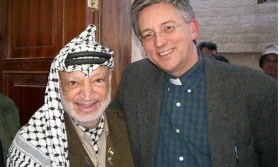
photo-298x1671
Steven Sizer with Yasser Arafat

Sizer seems unembarrassed by the fact that his own remarks and writings stray into anti-Semitic territory. For instance, he once stated that the reason Jews “were expelled from the land was that they were more interested in money and power and treated the poor and aliens with contempt.” In 2011, he posted a link on his Facebook page to an anti-Semitic website called “The Ugly Truth,” and in the same year, he went to Malaysia to work with Viva Palestina, whose leading activists include Holocaust-denier Matthias Chang.

Another Anglican notable, Desmond Tutu, has likened Zionism to racism and repeatedly referred to Israel as an “apartheid” state. He is also a supporter of boycotts. Tutu, a friend of Yasser Arafat and Hamas’s Ismail Haniyeh, accepted the role as patron of Sabeel International in 2003. This is the same Sabeel that is spearheading the Christian Palestinianist movement in the Middle East. It is perhaps no surprise that US attorney Alan Dershowitz has called Tutu a “racist and a bigot.”

The number of Christian organizations censuring the Jewish state is increasing. It is common for left-wing Christians to exonerate the Palestinians of any historical and contemporary accountability, thereby holding Israel solely responsible for ending the crisis. In 2009, the Central Committee of the World Council of Churches released a statement condemning the so-called Israeli occupation and encouraging a boycott of goods made in settlements. Significantly, the World Council of Churches is also calling for the internationalization of Jerusalem.

Meanwhile, Christian Aid and the Quakers are calling on the UK government to implement a total ban of settlement goods. In North America, the United Church of Canada is heading towards an official boycott policy. And the Church of England, which has a large overseas membership, is considering whether it should adopt the World Council of Churches’ Ecumenical Accompaniers Programme in Palestine and Israel. The EAPPI is blatantly pro-Palestinian and holds the Jewish state solely responsible for resolving the situation in the West Bank.

A religion of resentment 
Christian Palestinianism is a religion of resentment. It is a projection of a sense of inferiority onto an external scapegoat. Thwarted by failure, Christian Palestinianists blame their problems on “the Jews.” The God of Israel is declared dead, only to be replaced by the anti-Semitic God of Palestine.

Propoganda portraying Yeshua as "Palestinian"

Of all the anti-Israel discourses that exist today, Christian Palestinianism is perhaps one of the most shocking. Shocking because it wants to de-Judaize the Bible and undermine Jewish identity. Shocking because it also revives the notion of Jews as killers of Christ. Moreover, the post-Holocaust reconciliation of Jews and Christians is lethally undermined. The work of Geza Vermes, and others like him, who have examined in close detail the Jewishness of Jesus, is being cast aside in favour of a quasi-gnostic Jesus.

On a theological level, Christian Palestinianism is entirely self-defeating. If God no longer honours his covenant with the Jews and the Land of Israel, then the whole foundation of Christianity collapses. A God who changes his mind about the Jews is no longer the God of Abraham, Moses or Jesus. Palestinianism is not only un-Biblical, it is un-Christian.

Pro-Palestinian Christians in the West need to take a long, hard look at themselves and ask whether it is ethical to be consorting with liars, terrorists and anti-Semites. They should also ask themselves if their actions are likely to lead to a fresh outburst of religiously-motivated anti-Semitism. The trouble is, history shows that many Christians need no excuse to persecute the Jews. There seems to be an in-built tendency to raise their fists against the descendants of Isaac and Jacob. This is bad news not only for the State of Israel and the Jewish diaspora, but also for Christianity itself, which will not survive another destructive wave of anti-Semitism.

As it says in Ezekiel 35, “Because you harbored an ancient hostility and delivered the Israelites over to the sword at the time of their calamity, the time their punishment reached its climax, therefore as surely as I live, declares the Sovereign Lord, I will give you over to bloodshed and it will pursue you. Since you did not hate bloodshed, bloodshed will pursue you.”