Friday, January 19, 2018

Isaiah Post 41 - Messiah, The Land, and The Wedding (Chapter 61)

Isaiah 61 starts out like this:

“The Spirit of the LORD God is upon Me,
Because the LORD has anointed Me
To preach good tidings to the poor;
He has sent Me to heal the brokenhearted,
To proclaim liberty to the captives,
And the opening of the prison to those who are bound;
To proclaim the acceptable
(favorable) year of the LORD, 

Sound familiar?  And notice the comma?  We'll come back to that.

In Luke 4, Yeshua read these very words in His hometown, but stopped halfway through verse 2, (where I stopped above) and said, “Today this scripture is fulfilled in your hearing." And then He handed the scroll to the attendant.

First, I want to mention that word anointed.

That word in Hebrew is Mashiach (or as we say it in English - Messiah).

The word literally means smeared with oil. The Hebrew word carries with it the connotation of being chosen and made ready for something. Oil represents the Holy Spirit. The Greek word Christos, from where we get the word Christ, simply means oily one. There was no Greek word equivalent in meaning to the Hebrew word.  I wonder how many people still consider Christ to be the last name of Jesus?  I know I did for many years.

OK, back to Luke 4. The people in the synagogue did not react well to Yeshua's statement. This young man was a simple carpenter’s son, and they’d known Him His whole life. They knew that "the anointed one" was to be the coming Messiah. And that is exactly who Yeshua was claiming to be.

Let's look now at the place where Yeshua stopped reading:

To proclaim the acceptable year of the LORD,
And the day of vengeance of our God;

This is one of those spots in Isaiah where we have a prophecy that contains His first and second comings in one sentence. Yeshua stopped reading before the part of God's vengeance, because that will be part of His purpose when He returns to earth.

It is possible that the people were angry because they felt Yeshua stopped short in the prophecy.  The Jews at that time were awaiting deliverance from Rome's heavy oppression, not from their sin.  The people went so far as to try and throw Him off a cliff. 

Mount Precipice near Nazareth, commemorating Luke 4.

Isaiah's prophecy continues with verse 2B through 4, in the last days context of the coming Kingdom and His return.  

To comfort all who mourn,
To console those who mourn in Zion,
To give them beauty for ashes,
The oil of joy for mourning,
The garment of praise for the spirit of heaviness;
That they may be called trees of righteousness,
The planting of the Lord, that He may be glorified.”

And they shall rebuild the old ruins,
They shall raise up the former desolations,
And they shall repair the ruined cities,
The desolations of many generations.


What a wonderful promise to a people group, who wandered throughout the earth without a country of their own, and who are now coming home.

When you fly into Tel Aviv, you see restoration all over the place.  Fields, towns, cities, roads, and lots of green.  New buildings have replaced ruins.

Isaiah continues:
Strangers shall stand and feed your flocks,
And the sons of the foreigner
Shall be your plowmen and your vinedressers.


This last  part of this verse is what moved Tommy Waller to start the ministry HaYovel, meaning The Jubilee. Gentiles come from all over the world to work with this ministry in the Biblical heartland of Judea and Samaria, helping farmers plant and harvest grapes for wine.

The last several verses of Amos are in parallel to much of this chapter.  Most of the book of Amos is doom and gloom for Israel, but yet at the end... restoration!  Look at Amos 9:13-15

“Behold, the days are coming,” says the Lord,
“When the plowman shall overtake the reaper,
And the treader of grapes him who sows seed;
The mountains shall drip with sweet wine,
And all the hills shall flow with it.

I will bring back the captives of My people Israel;
They shall build the waste cities and inhabit them;
They shall plant vineyards and drink wine from them;
They shall also make gardens and eat fruit from them.

I will plant them in their land,
And no longer shall they be pulled up
From the land I have given them,”
Says the Lord your God.

Isaiah continues in verses 6-7, speaking to and of Israel;
But you shall be named the priests of YHVH,
They shall call you the servants of our God.
You shall eat the riches of the Gentiles,
And in their glory you shall boast.
Instead of your shame you shall have double honor,
And instead of confusion they shall rejoice in their portion.
Therefore in their land they shall possess double;
Everlasting joy shall be theirs.

Talk about a reversal of history here!  Instead of being the scapegoat of the nations, Israel will eat the riches of the nations.  And double honor instead of shame is quite the contrast!

(The ideology of shame and honor is deeply ingrained into Middle Eastern cultures.  This is why honor killings still exist in the Muslim world today.   To most cultures, such a thing is horrific.  But to someone steeped in the shame versus honor ideology, they believe they can do no less.)

Like much of last days Bible prophecy, there is a clear connection to the land.  This connection goes all the way back to the Abrahamic covenant of 4000 years ago.  The everlasting covenant of the land, the seed, and the blessing is still in effect today.

The Land of Israel is central to last days action.  This is why that tiny piece of land (that can fit entirely into Lake Michigan) is always in the news.  And the Temple Mount is at the center of the battle. Without the Jews back in their homeland, Yeshua cannot return to Jerusalem and take His rightful place on the throne, which will be in His rebuilt temple.

Verse 8 moves on to let us know that YHVH loves justice and also hates robbery for the purpose of the burnt offering.  Isaiah then mentions the everlasting covenant that YHVH will make with His people.  He is speaking here of YHVH’s seventh covenant, the covenant of peace, which is everlasting and will be instituted in the coming Millennial kingdom.   (Do you need a refresher on God's seven covenants with man? Click here for a brief but important rabbit trail).

What we know as the New Covenant, the shedding of Messiah’s blood, will have been a done deal by this point in Isaiah’s prophecy. Israel as a nation will be brought back into an everlasting covenant  of peace with YHVH because of the blood of Messiah. The bible often repeats: I will be glorified in my people Israel.

The final two verses of Isaiah 61 give us an amazing picture of the wedding of the Lamb and the coming Messianic Kingdom. A wedding is one of the most joyous things of all! (unless you are the one paying for it, tee hee).

The wedding is pictured in verse 10:
I will greatly rejoice in the LORD,
My soul shall be joyful in my God;
For He has clothed me with the garments of salvation,
He has covered me with the robe of righteousness,
As a bridegroom decks himself with ornaments,
And as a bride adorns herself with her jewels.

Let us be glad and rejoice and give Him glory,
for the marriage of the Lamb has come, and His wife has made herself ready.
Revelation 19:7

God demonstrates salvation and righteousness together with a wedding. The coming Kingdom will be kicked off with a wedding feast, also known as Sukkot, or Feast of Tabernacles. All nations will be celebrating this.  Sukkot is the seventh and final appointed time of the LORD.

Verse 11 says,
For as the earth brings forth its bud,
As the garden causes the things that are sown in it to spring forth,
So the Lord God will cause righteousness and praise to spring forth before all the nations.


Again, the land:  it is central! The garden is a throwback to the Garden of Eden where it all began.  The righteousness that was lost 6000 years ago will spring forth once again, amidst praise!

Sowing is in the spring. With His first advent, Yeshua fulfilled the spring feasts. The seeds have been sown and grown during the last 2000 years.  The final harvest is soon to come, and will involve the whole world!


The next post is available here.

If you missed the beginning of this series on Isaiah, you can click here to start at the first post.

Monday, January 15, 2018

Isaiah Post 40 - The Nations WILL Bless Zion (Chapter 60)

Seven more chapters!  Only seven more!  I feel like the coach in Facing the Giants... four more downs!  (If you haven't seen it, you should.  A perfect blend of a guy movie and a chick movie and filled with faith).

Four more downs!!!

 We are almost to the end of the amazing Book of Isaiah.

Today, we look at chapter 60, which starts out quite vividly:

Arise, shine;
For your light has come!
And the glory of the LORD is risen upon you.
For behold, the darkness shall cover the earth,
And deep darkness the people;

But the LORD will arise over you,
And His glory will be seen upon you.
The Gentiles shall come to your light,
And kings to the brightness of your rising.


We see here a call to God's people to rise and shine His love.  We also see a description of our world today, which is covered in darkness. We are living as in the days of Noah. Even the LORD's rainbow was stolen for unholy purposes. Good is called evil and evil is called good.

BUT, as the passage continues, we see the promise that the LORD will arise over you, and His glory will be seen upon you.  You is specifically Israel here.

Verse three moves along with the prophecy that the nations shall come to your [Israel's] light, and kings to the brightness of your [Israel's] rising.
        
Israel arose out of the ashes of nearly 2000 years in 1948.  Since then, they have been visited by kings and dignitaries from ALL OVER THE WORLD.  You can walk through the King David Hotel and see a long, indoor walkway with signatures of modern-day dignitaries and celebrities on them - including Winston Churchill, Jackie Kennedy, Isaac Stern, both George Bushes, Nelson Mandela, and Metallica, to name a few.  In fact, I have been in Israel during the visits of the Pope and President Trump.  Both visits were very interesting!

Famous indoor sidewalk at the King David Hotel


The passage continues:  LIFT UP YOUR EYES AND SEE: Sons and daughters are gathering together, coming from afar.  This is the miracle of the Jewish people returning to their ancient homeland of Israel.

Look at verse 5:
Then you shall see and become radiant,
And your heart shall swell with joy;
Because the abundance of the sea shall be turned to you,
The wealth of the Gentiles shall come to yo
u.

People ask me why I continue to visit Israel.  How can I stay away, when I see God's word being fulfilled right under my nose??

The prophecy of blessing to Israel from the nations continues in verses 6-7.  Some of this is happening now, but because such places as Midian and Kedar are mentioned, we can expect much of this to be fulfilled in the future.  Both of these places are in Saudi Arabia, and relations between the two countries are not warm and fuzzy.  For example, if you have an Israeli visa stamp in your passport, Saudi Arabia will not even let you enter the country.  There is, however, a slight warming taking place between the two countries.  Iran is a mutual enemy.  Could it be said that the enemy of my enemy is my friend?

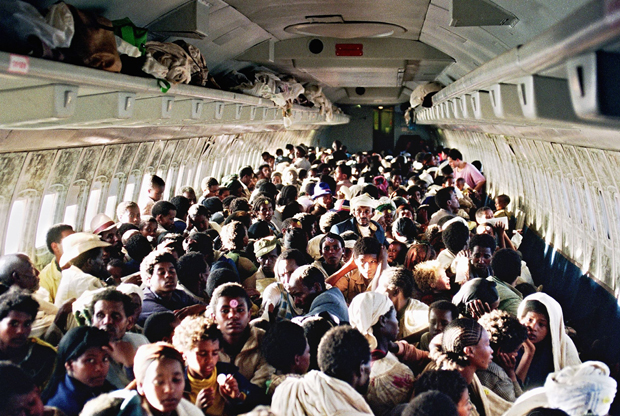
Verse 8 is so interesting:  it asks the question, Who are these who fly like a cloud, and like doves to their roosts?  WHAT was Isaiah seeing?  Was he seeing the planeloads of Jews returning to the Land?  It happens constantly now.  Jews are being brought home by the planeload from all over the world.  It happens constantly now, but here are a few notable examples:

  • Operation Moses 1984-1985, a covert rescue of Ethiopian Jews from camps in Sudan
  • Operation Solomon, 1991 (14.000 Jews evacuated from Ethiopia over a period of 2 days)
  • Operation Exodus - Currently brings planeloads of Jews from the US to Israel
  • Nearly one million Jews have emigrated from the former Soviet Union, mostly on planes
Ethiopian Jews being flown to Israel
Israel contains numerous aliyah return centers, which help new immigrants get settled, find jobs, and learn Hebrew.

Verse 9 continues with a prophecy that the coastlands are waiting and ships are bringing back the sons and daughters of Israel!  And today it is not just airplanes, but ships that are returning Jews to the land as well – especially since World War 2.  I recommend the book Exodus by Leon Uris.  It's long, but vividly tells the story of immigrants coming back to the land of Israel and making it bloom.

Verse 10 begins a section where the Gentiles are plunged into the action as well.
And their kings shall minister to you;
For in My wrath I struck you,
But in My favor I have had mercy on you.

Therefore your gates shall be open continually;
They shall not be shut day or night,
(Today the city gates are always open and don't close at night, except following an occasional terror attack or security for a dignitary's visit)

That men may bring to you the wealth of the Gentiles,
And their kings in procession.
Yep.  Happening.

For the nation and kingdom which will not serve you shall perish,
And those nations shall be utterly ruined.

Oh that more nations would heed this prophetic warning.

"The glory of Lebanon shall come to you,
The cypress, the pine, and the box tree together,
To beautify the place of My sanctuary;
And I will make the place of My feet glorious.
This is describing the soon-to-be-built temple.  The second temple was built after the return from Babylon, and then was later beautified by King Herod, just in time for the feet of the Messiah to walk there.  The next temple will be built for the same purpose.

Also the sons of those who afflicted you
Shall come bowing to you,
And all those who despised you shall fall prostrate at the soles of your feet;
And they shall call you The City of the Lord, Zion of the Holy One of Israel.

“Whereas you have been forsaken and hated,
So that no one went through you,
I will make you an eternal excellence,
A joy of many generations.

Wow, what a turnaround of events.

Let me give you a quick testimony from a rabbi friend of mine who is building a unique farm and yeshiva (Bible school) in the Judean desert. A group of Germans came there last year to help them build the walls of the facility.  The German visitors worked from sunup to sundown while they were there. They were children of World War 2 Nazis.

The Jews have been irrationally hated for millennia.  This scripture lets us know that there will be an end to the hatred.  And history is beginning to prove that this is so... albeit slowly.

Chapter 60 continues with a reference to drinking the milk of the Gentiles.  A mother nursing her child provides physical sustenance and love.  In the same way, the nations will be doing the same to Israel.

Verse 17 is interesting:
“Instead of bronze I will bring gold,
Instead of iron I will bring silver,
Instead of wood, bronze,
And instead of stones, iron.


We see a picture of substances being upgraded, all the way to God.  We are being shown an allegory of the reversal of sin, with the ultimate substance being gold.

Substances in scripture represent different things:

  • Gold represents God:  His divineness and deity.
  • Silver represents redemption
  • Bronze is a representation of sin and the altar
  • Iron represents strength, crushing, and inflexible rule
  • Wood  represents perishable man.
Stones. however, carry many meanings in scripture.  Rocks can be jagged or smooth.  They can be instruments of destruction.  David killed Goliath with a stone, which had been smoothed out by living water.  They can also be foundational to a building.  The Messiah is our cornerstone.  We believers are all living stones, part of His spiritual building.

The scripture continues:
I will also make your officers peace,
And your magistrates righteousness.
Violence shall no longer be heard in your land,
Neither wasting nor destruction within your borders;
But you shall call your walls Salvation,
(Yeshua)
And your gates Praise.

No more violence!! We know this is a future prophecy because there is still much violence today.

A note about the gate of Praise...  The only non-Muslim entrance to the Temple Mount has been historically called the Mughrabi bridge.  Last year, a 13-year-old girl named Hallel was murdered in her bed by a terrorist who had broken into her family's home.  In her memory, the name of this entrance was changed to Hallel Gate.  Hallel, as you may know, means praise.

The Hallel Gate, formerly known as the Mughrabi

Chapter 60 wraps up nicely with a lovely picture of the coming kingdom:

“The sun shall no longer be your light by day,
Nor for brightness shall the moon give light to you;
But the LORD will be to you an everlasting light,
And your God your glory.
Your sun shall no longer go down,
Nor shall your moon withdraw itself;
For the LORD will be your everlasting light,
And the days of your mourning shall be ended.
Also your people shall all be righteous;
They shall inherit the land forever,
The branch of My planting,
The work of My hands,
That I may be glorified.
A little one shall become a thousand,
And a small one a strong nation.
I, the Lord, will hasten it in its time.”

Compare this passage to Revelation 21:23-26:
The city had no need of the sun or of the moon to shine in it, for the glory of God illuminated it. The Lamb is its light. And the nations of those who are saved shall walk in its light, and the kings of the earth bring their glory and honor into it. Its gates shall not be shut at all by day (there shall be no night there). And they shall bring the glory and the honor of the nations into it.

This even goes beyond the Millenial kingdom to the New Jersualem, which comes down to earth after the 1000 years. 

Jerusalem is absolutely central to God’s plan. It’s why it is the center of world attention, especially today. Psalm 2 says,  - Why do the nations rage, And the people plot a vain thing?... Yet I have set My King On My holy hill of Zion.”

Can we even imagine how it will be?

The next post is (finally) ready.  Click here.

To start at the beginning of this series on Isaiah, click here.


Tuesday, January 9, 2018

Isaiah Post 39 - Our Great Intercessor Who Will Conquer (Chapter 59)

I just went back and read my introductory post on this walk through Isaiah. It made me chuckle: I guessed that there would be a few weeks of posts! Last year, I had spent a half year teaching through Isaiah in our Sunday school class. I guess I underestimated the time it would take to turn the outlines of my notes into something readable.

Anyway, if you are here, thanks for sticking with me. Today we will look at Isaiah 59.

Verses 1-15 give us a very accurate description of the evil of mankind. I'm not going to post it here; you can read it on your own. The apostle Paul quoted verse 8 in his own outline of man's evil in Romans chapter 3. There is nobody who is righteous on their own!

The LORD was displeased by the lack of justice, verse 15 tells us.  But then, Isaiah drops this prophetic bombshell in verse 16:
He saw that there was no man,
And wondered that there was no intercessor;
Therefore His own arm brought salvation for Him;
And His own righteousness, it sustained Him.


Did you catch that?  HIS OWN ARM brought Salvation. Yeshua our Messiah, is not just at the right hand of God, He is the right hand of God. God is spirit. Jesus is the action arm of God – literally. God LOVES, Jesus DOES, through the POWER of the Holy Spirit.

Give me a moment for a tangent.  Here is a picture that we have from the Hebrew scriptures - the difference between Noah and Moses.

Noah was able to save himself and his family on the ark that he built, but the rest of the world was destroyed. Noah is not really a picture of an intercessor.

Moses, on the other hand, led his people to salvation through the Red Sea with outstretched arms,  Later, Moses pleaded with God not to destroy the Israelites, interceding for them in Exodus 32:10 when God’s anger burned against their unfaithfulness.  Moses was a true intercessor.  


The LORD then gives this promise in Deuteronomy 18:18:
I will raise up for them a Prophet like you from among their brethren, and will put My words in His mouth, and He shall speak to them all that I command Him.

Yeshua is that Prophet, likened to Moses who interceded for his sinful people.  Yeshua is our ultimate intercessor.  And like Moses did with the Israelites, Yeshua redeemed us with outstretched arms.

Cursed is anyone who hangs on a tree
Deuteronomy 21:23 and Galatians 3:13

The remainder of chapter 59 switches gears and foretells of His future redemption when He returns to Zion as a conquering King and redeems the remnant of Jacob. He will fully vanquish His enemies. It will be the ultimate spiritual warfare, and we know Who wins.

I want to talk about verse 17, which sets up the whole scenario:
For He put on righteousness as a breastplate,
And a helmet of salvation on His head;
He put on the garments of vengeance for clothing,
And was clad with zeal as a cloak.

This will sound familiar to anyone who has studied Ephesians 6 and the armor of God.  I had to admit surprise when I discovered that the concept was rooted in Isaiah.

In Ephesians 6, we find six pieces of armor.  I was also surprised to learn that there are three pieces that we already have, and three more pieces that we are instructed to take up.

We already have:
  • The girdle of truth around our waist
  • The breastplate of righteousness 
  • Our feet prepared with the gospel of peace

We are instructed then to take up:
  • The shield of faith
  • The helmet of salvation
  • The sword of the Spirit - the Word of God

At the moment of our justification - the moment we receive Yeshua and His redemptive sacrifice to forgive our sins - He equips us with the first three pieces.  We accepted the truth of Him, He gave us righteousness, and prepared us to share it with others.

For the rest of our lives, as we walk with Him, we must then actively, and daily, take up the last three pieces -  working out our salvation.  This is our process of sanctification, and does not end until we take our last breath.  We take up the shield of faith when we resist the devil's schemes.  We put on the helmet of salvation every time we renew our minds and take every thought captive.  We wield a sword every time we pick up God's word and digest it.


If you have read my blog before, or understand the meaning of numbers in scripture, you might find it interesting that there are six pieces of armor mentioned in Ephesians 6.  Just one short of seven, which represents perfection, or completeness.

It is also interesting to note that Isaiah 59:17 features the LORD with one piece of armor from each category.  But the second half of that verse speaks of something else entirely - the garments of vengeance, also depicted as a cloak of zeal.  

This is the seventh and final Biblical piece of armor. This piece is not for us. It belongs to God alone. 
Verse 18 clearly shows this:
According to their deeds, accordingly He will repay,
Fury to His adversaries,
Recompense to His enemies;
The coastlands He will fully repay.


This will happen upon His return.  The wrath of God will be poured out on the earth at His return. Scripture says, "Vengeance is mine, I will repay."   The LORD says this in Deuteronomy 32:35, it is repeated in Romans 12:19, and it plays out in the book of Revelation, especially in chapters 8, 9, and 14.

And of course, this entire section ends with the promise of redemption for Jacob. Paul quotes the last two verses of Isaiah 59 in Romans 11:
And so all Israel will be saved,as it is written:
“The Deliverer will come out of Zion,
And He will turn away ungodliness from Jacob;
For this is My covenant with them,
When I take away their sins.”

Can I get an amen here?  This is the grand event that is going to wrap up human history. The gospel which began at Jerusalem has nearly circled the world, and will be completed there very soon.

The next post is up.  Click here to read it.


If you'd like to read through my entire series on Isaiah, click here.


Monday, January 8, 2018

Isaiah Post 38 Mercy, Hypocrisy, and Sabbath Blessings (Chapter 58)

Chapter 58 opens with the admonition to "tell my people their transgression." Without the acknowledgement of sin, there is no gospel.  People must know that it is our sin that keeps us from a relationship with our Creator, and they must know that there is One who shed His innocent blood in order to pay our price for us.

Atonement requires blood

In verse 2, we are told that they think they DO seek God and that they DO delight in Him and His justice.  But then they pose the question, "Why haven't You seen our fasts or notice our afflictions?"

Verses 3-7 record a rebuke of their hypocrisy. They are doing evil to innocent people, but then pretend to do good by fasting and being religious.  But God wants justice and mercy before sacrifice.

Yeshua often confronted this attitude with the religious leaders. 

Mercy is better than sacrifice

Verses 8-11 outline the blessings that will come by treating people the way God has commanded, without the hypocrisy. In fact, the picture we are given of this promise is quite vivid:

Then your light shall break forth like the morning,
Your healing shall spring forth speedily,
And your righteousness shall go before you;
The glory of the LORD shall be your rear guard.
Then you shall call, and the LORD will answer;
You shall cry, and He will say, ‘Here I am.’

Verse 12 then addresses those among you –  the passage is speaking of future Jewish people who would raise up the foundations of Israel – old waste places, foundations of many generations. This building up of the land is a repeat of  Isaiah 44:26, and it is happening today in Israel.

I love the two titles that they are given:
  • Repairers of the Breach
  • Restorer of Streets to Dwell in
The next two verses wrap up this chapter, mentioning the Sabbath again, (which we spoke about in the previous post on Chapter 57). This appointed times of the LORD, including the Sabbath, will also be kept in the 1000 year kingdom, along with animal sacrifices. How do we know this? You can read Ezekiel chapters 44-46, which describe the coming Messianic kingdom.

There is blessing in this particular obedience:
“If you turn away your foot from the Sabbath,
From doing your pleasure on My holy day,
And call the Sabbath a delight,
The holy day of the LORD honorable,
And shall honor Him, not doing your own ways,
Nor finding your own pleasure,
Nor speaking your own words,
Then you shall delight yourself in the LORD;
And I will cause you to ride on the high hills of the earth,
And feed you with the heritage of Jacob your father.
The mouth of the LORD has spoken.”

Experiencing the Sabbath in Israel is a beautiful thing.  Cell phones are turned off, cars stay put, and people simply enjoy resting in the LORD and having fellowship with one another.  It is harder to celebrate in our culture, because the world continues to swirl around us all weekend long.

It has been said that historically, it wasn't that the Jews kept the Sabbath, but that the Sabbath kept the Jews.  Wherever they have been in the world, the Sabbath was honored.  And now it has been brought home to the land of Israel.

Every Friday evening, Jewish people all over the world enjoy communion with one another and with God as they light candles and serve bread and wine at their Shabbat tables.  Bread and wine!  And not  only that, but they sprinkle their bread with salt. (Salt is a preservative). Can you imagine the aha moment, when they see Who has been symbolized in their celebrations all these years?


I can hardly wait to celebrate the Sabbath with King Messiah and all His people together!

The next post is available.  To read it, click here.


If you would like to start at the beginning of this series on Isaiah, click here.

Friday, January 5, 2018

Isaiah Post 37 - Know God, Know Peace (Chapters 56-57)

This will be a longer post today as I want to cover two chapters.

We now move to chapter 56. The chapter opens with a command to keep justice and righteousness. Why? Because Salvation (Yeshua) is about to come!

As a Gentile myself (well, ancestry.com tells me I am 6% Jewish), verses 3-8 really speak to me.

Do not let the son of the foreigner
Who has joined himself to the LORD
Speak, saying,
“The LORD has utterly separated me from His people”;
Nor let the eunuch say,
“Here I am, a dry tree.”
For thus says the LORD:
“To the eunuchs who keep My Sabbaths,
And choose what pleases Me,
And hold fast My covenant,
Even to them I will give in My house
And within My walls a place and a name
Better than that of sons and daughters;
I will give them an everlasting name
That shall not be cut off.

“Also the sons of the foreigner
Who join themselves to the LORD, to serve Him,
And to love the name of the LORD, to be His servants—
Everyone who keeps from defiling the Sabbath,
And holds fast My covenant—
Even them I will bring to My holy mountain,
And make them joyful in My house of prayer.
Their burnt offerings and their sacrifices
Will be accepted on My altar;
For My house shall be called a house of prayer for all nations.”
The Lord God, who gathers the outcasts of Israel, says,
“Yet I will gather to him
Others besides those who are gathered to him.”


In these verses, the LORD declares a promise to the eunuchs, that they would have a place in His house. In the Moses covenant, eunuchs and other "defective" people could not approach God in the temple, per Leviticus 21:16-23. This had to be great news for those people, who previously must have felt marginalized by their own society.

Speaking of marginalized, I just saw the movie The Greatest Showman last night. I highly doubt that the movie accurately depicted PT Barnum's life and ideals. However, the Hollywood version portrayed various "defective" people - who had been hidden in shame by their families and demeaned by the world - as being elevated in society and becoming members of a loving circus family.

The various outcasts in The Greatest Showman

In the time of Isaiah, Gentiles were considered to be on the same level as the defective people outlined in Leviticus. Gentiles were even referred to as dogs. But as the Syro-Phonecian woman tells us in Matthew 15:27, even the dogs get the crumbs from the master’s table. Isaiah assures us that the invitation will be opened to all!


Verse 5 mentions the term a place and a name. In Hebrew, it is yad vashem. This is also the name of the Holocaust museum in Jerusalem. The museum gives the victims a name and a place, and they SHALL be remembered - a everlasting name that shall not be cut off, as Isaiah says.

Hall of Names, Yad Vashem in Jerusalem

There are numerous references to the Sabbath in this section. The Sabbath was always the pinnacle of keeping the Torah. So it begs the question: is keeping the Sabbath still for today? Are the 10 commandments? It seems to me that the church is gung ho for nine of the commandments, but this one seems to get a pass. (But at least they make the effort to bring it back up to 10, adding "Thou Shalt Tithe").

A little history... In the 4th century, all biblical feasts including Sabbath observation were made illegal under Constantine and the Holy Roman Empire. The day of worship got moved to Sunday (Sunday was not called a day of rest until the Reformation). Constantine was a lifetime member of the cult of Mithra - a sun god worshipper, even though he professed Christianity as well.

What did the early believers do? Acts 20:7 is a very interesting verse. Every single translation I looked at starts out with on the first day of the week. But a quick look at the original language in my trusty Blue Letter Bible app shows the Greek term mia sabbaton, which means on a certain Sabbath.  The first day of the week was always a work day in Israel.  It still is.

The very word Sabbath (Hebrew shabbat) comes from the root word for seven – sheva. It is the day that God Himself rested after all His work of creation. It is the only biblical appointed time that pointedly acknowledges God as creator. Today, creation is under attack. Observing the Sabbath honors the work that God did, and flies in the face of evolution.

This chapter leaves little doubt in my mind that those outside who join themselves to the LORD now have a directive to keep the Sabbath. However, the way a person honors the Sabbath today needs to be spirit-led, as under the New Covenant law. But it helps knowing what the Sabbath actually is!

Please note: It is not wrong to worship God on ANY day of the week!

Moving on... verse 7 says, EVEN THEM I will bring to My holy mountain (where the soon-to-be-built temple will stand - in Jerusalem). Who is even them referring to? Isaiah says, the sons of the foreigner. Ephesians 2:12-13 tells us: Therefore remember that you, once Gentiles in the flesh—who are called Uncircumcision by what is called the Circumcision made in the flesh by hands— that at that time you were without Messiah, being aliens from the commonwealth of Israel and strangers from the covenants of promise, having no hope and without God in the world. But now in Messiah Yeshua you who once were far off have been brought near by the blood of Messiah.

And of course the verse wraps up with the lovely prophecy that it WILL BE a house of prayer for all nations. This is a promise that is awaiting fulfillment.

Yeshua quoted this in Matthew 21 when He overturned the tables of the merchants. It was not wrong to buy and sell at the temple. People going up to Jersualem to visit the temple HAD to buy their sacrifices there. What was wrong was the fraudulent activity - cheating people. Verse 1 of this chapter emphasized justice and righteousness.

Defective animals would be sold to the worshippers at exorbitant prices, and then the priests would not accept them for their sacrifice. The defective lambs would be returned to the vendors and get sold over and over again.

Chapter 56 opened with a plea for justice and righteousness, but it closes with a description of the injustice that was going on among the watchmen and shepherds: in other words, the corrupt leadership of the temple.  


Moving on to Chapter 57, verses 1-2 could be summarized with a Billy Joel song title:  "Only the Good Die Young."  However, it also says that nobody considers that they are removed from evil.  I believe this is what happened to Enoch in Genesis. He walked with God, and then God removed him to spare him from evil.

The section that follows in verses 3-13 is an admonition against idol worship - a very common biblical theme.  It's probably why it is the first of the ten commandments.  No. Other. Gods.

Verse 8 speaks of the shame of being uncovered. Someone should tell this to society today. There is a lot of pride in being uncovered and exposing our private stuff. In the scriptures, nakedness is always linked to shame (except in the presence of your beloved).  

In Genesis 2, nakedness was the last thing spoken of before the fall. They were naked and unashamed. There was no sin yet, and no need for covering.

It is interesting to note then, that the first thing they notice after their sin is their nakedness. Deeply ashamed, Adam and Eve tried to sew fig leaves for themselves - a picture of us trying to atone for ourselves through our own works.  But no.  God demonstrated right there in Genesis 3 that blood was required for covering when He provided them with animal skins.  

Our own striving just doesn't cut it.

Even though this section of scripture warns against idolatry, it ends on a high note:
But he who puts his trust in Me shall possess the land,
And shall inherit My holy mountain.”


The passage continues:  Heap it up! Heap it up! Prepare the way!  We see a foretaste of John the Baptist here.

Verse 15 continues:
For thus says the High and Lofty One
Who inhabits eternity, whose name is Holy:
“I dwell in the high and holy place,
With him who has a contrite and humble spirit,
To revive the spirit of the humble,
And to revive the heart of the contrite ones.


Our God lives in a high and lofty place, but He ALSO dwells with those who have a lowly, humble, and contrite spirit. He revives the spirits of the crushed and lowly ones.  This brings to mind the beatitudes of Matthew 5.  How blessed are those who are meek, humble, lowly, and so forth!

What follows in verses 16-19 is a promise by God that His anger will not be angry forever (but He definitely was angry). God has seen our ways, but He will heal, guide, and restore. He loves to forgive! He offers peace to those far off and peace to those who are near. Many wicked will turn to Him.  He has compassion toward backsliders and offers them grace and mercy.

But verses 20-21 tell us that not all will receive His message of reconciliation. The wicked are likened to waters that cast up mire and dirt, creating mud.  Alas, for them, there is no peace.


The next post is ready!  Click here to read it.

To start at the beginning of this walk through Isaiah, click here.

Thursday, January 4, 2018

Isaiah Post 36 - All Creation Celebrates! (Chapter 55)

After all the rejoicing and promises in chapter 54, can it get any better? Why yes. Yes it can.

Chapter 55 opens up with an invitation:
“Ho! Everyone who thirsts,
Come to the waters;
And you who have no money,
Come, buy and eat.
Yes, come, buy wine and milk
Without money and without price.


Everything previous is just so good! Come to the waters! Come and eat! It’s all free – paid for by our Messiah! Ho!

Verse 2 poses to us a very good question.
Why do you spend money for what is not bread,
And your wages for what does not satisfy?
Listen carefully to Me, and eat what is good,
And let your soul delight itself in abundance.


Really... why DO we strive so hard for stuff that does not satisfy?  We need to eat what is good:  The Word of God.  In Matthew 6, when Yeshua was teaching His disciples to pray, He said, "Give us this day our daily bread."  

Was He talking about food there? I believe not. If you skip ahead in Matthew 6 to verse 25, Yeshua asks this:
“Therefore I say to you, do not worry about your life, what you will eat or what you will drink; nor about your body, what you will put on. Is not life more than food and the body more than clothing?

These can be hard words for me.  I'm a foodie.  I love food, I love cooking, and I love to eat.  In fact, "Eat!" was my very first word as a baby.

Thankfully, I have come to love the Word of God, and I am so grateful for that Daily Bread.


Our chapter continues in verses 3 and 4 with a plea and a promise. Incline your ear!  Come to Me!  Listen and live! What follows is a reference to David, who was given as a witness and to whom was given a covenant (2 Samuel 7 outlines the Davidic covenant, which is the promise of a coming King from the house of David, whose reign will never end).

In verses 5-7, Isaiah speaks about the nations outside of Israel who will seek Him.  He encourages the world to seek Him.  This includes us! The time to seek Him is NOW, today, while we are alive. We don’t know how long we have. Our birth certificates do not come with expiration dates. Today is the day of salvation.  If you hear His voice today, receive Him!  Do not harden your heart against Him.

Verse 7 includes a plea to the wicked:  forsake your ways! Return to the LORD, for He is merciful and will pardon!

The LORD is merciful and will pardon the wicked?  Yes, a thousand times yes!  How often do we hear the next two verses?
“For My thoughts are not your thoughts,
Nor are your ways My ways,” says the LORD.
“For as the heavens are higher than the earth,
So are My ways higher than your ways,
And My thoughts than your thoughts.

How much higher are His ways? He is so much bigger, so much higher than we could ever be. The gospel isn’t “fair”! All other religions teach man’s works for their own salvation. I don't think our human minds can fully fathom how great is His plan of salvation!

Verses 10 and 11 go on to liken His word to the rain that waters the earth. The context is still speaking about seeking Him. His Word will not return to Him void (meaning vainly, or empty), but it WILL accomplish His will and His purpose.

The word of God is sharper than a double edged sword,
and it is under ferocious attack in these last days.

The chapter wraps up with an awesome picture of the joy and celebration in the coming Messianic kingdom. Even the mountains and trees will celebrate! No more will there be thorns and briers, but beautiful foliage!  (As a gardener, can I get an amen here??  And may I politely inquire of the Lord about the fate of  mosquitoes while I am at it?)

All of creation will celebrate the King!  I can hardly stand waiting sometimes.


Before I post this edition, I want to camp on the thorn bush for a moment.  (Not literally).

First, some thoughts: 
  • The word for “bush” in both Hebrew and Greek is not simply bush, but thorn bush.
  • Biblically, the thorn bush is very significant.
  • Thorns represent sin and fallen creation. 
  • Thorns cause bloodshed.
  • God’s plan is to deal with sin.
  • Farmers know that before the harvest, the thorns must be addressed.

When we read about Moses and the burning bush story, we can look at the original Hebrew and see that the bush was a thorn bush.  It was actually the thorns that were on fire, but they were not burning up.
  • If thorns represent sinful man, the fire represents God
  • The thorns were not being destroyed.  Moses was perplexed.

What we have here is a picture of God dwelling with man, and man is not consumed (although he should be because of sin). It is a promise that God will deal with our sin.

After Moses saw the flaming thorn bush, he was eventually given instructions on how to build the mishkahn – the tabernacle. The final piece of furniture in the tabernacle, the Ark of the Covenant, was built out of acacia wood – a thorny tree. (Hebrew shettim)

The Ark, representing the place where God dwells, is acacia wood (thorny wood, representing man) covered in gold (representing the deity of God).

The word shekinah comes from the same root word as mishkah – the manifest presence of God.  The creator of the universe dwelling with man!

Let's go further... Fire and blood were both present in the tabernacle. The tabernacle featured fire on the altar, on the golden menorah, and on the altar of incense.

Blood was on the altar every day.  And then once a year, blood had to be sprinkled onto the Ark of the Covenant by the high priest.

In Leviticus 16:11-14, we see one of many places where the fire and the blood appear together:
“And Aaron shall bring the bull of the sin offering, which is for himself, and make atonement for himself and for his house, and shall kill the bull as the sin offering which is for himself. Then he shall take a censer full of burning coals of fire from the altar before the Lord, with his hands full of sweet incense beaten fine, and bring it inside the veil.  And he shall put the incense on the fire before the Lord, that the cloud of incense may cover the mercy seat that is on the Testimony, lest he die.  He shall take some of the blood of the bull and sprinkle it with his finger on the mercy seat on the east side; and before the mercy seat he shall sprinkle some of the blood with his finger seven times.

All of this is a shadow of the Messiah to come, whose blood saves us.  

Messiah had to die before there could be a harvest. On His head (the head is a picture of authority and kingship) was a crown of thorns, showing us yet another picture of how He conquered sin. 

Shortly after His return to heaven, tongues of fire appeared at Shavuot (Pentecost) when His Spirit began to dwell INSIDE man! (The apostles weren’t consumed by the tongues of fire).

(As I was writing this, two Jehovah's witnesses appeared at my door. I was able to share some of this with them before they scurried off).

So Isaiah 55 ends beautifully, with kingdom language - the world to come!  The thorns will be gone; dealt with; and all that remains is abundance and joy. We have a measure of that abundance and joy now as believers, but our joy will be complete in the soon-to-come Kingdom of Messiah when He returns and rules from Jerusalem!


The next post is ready!  To read, click here.

To start at the beginning of this series on Isaiah, click here.


Wednesday, January 3, 2018

Isaiah Post 35 - Future Glory (Chapter 54)

Ok, I'm back.  I planned to blog while in Israel but it just didn't happen.  Something about trying to write extensively on a cellphone just doesn't work well for me.

Anyway, here we are at chapter 54.

Isaiah is giving us a glimpse of the future glory because of the previous atonement that we saw in chapters 52 and 53.

Verse 1 jumps right into a joyful song:
“Sing, O barren,
You who have not borne!
Break forth into singing, and cry aloud,
You who have not labored with child!
For more are the children of the desolate
Than the children of the married woman,” says YHVH.


What is this talking about?  The barren woman here is unbelieving Israel.  Remember the question from chapter 53, "Who has believed our report?"  The nature of the question suggested that many would not believe.

But the good news is that this will change.  In the next few verses, Israel is then given wonderful promises:

“Enlarge the place of your tent,
And let them stretch out the curtains of your dwellings;
Do not spare;
Lengthen your cords,
And strengthen your stakes.
For you shall expand to the right and to the left,
And your descendants will inherit the nations,
And make the desolate cities inhabited.
“Do not fear, for you will not be ashamed;
Neither be disgraced, for you will not be put to shame;
For you will forget the shame of your youth,
And will not remember the reproach of your widowhood anymore.


And if all that isn't enough, verse 5 gets even better!

For your Maker is your husband,
The LORD of hosts is His name;
And your Redeemer is the Holy One of Israel;
He is called the God of the whole earth.


How lovely that our Redeemer is called the God of the whole earth!  This promise is to us along with Israel.  Together, we are His bride.  This is another place where we can see that the Messiah is God.

Verses 6-8 continue:
For the LORD has called you
Like a woman forsaken and grieved in spirit,
Like a youthful wife when you were refused,”
Says your God.
“For a mere moment I have forsaken you,
But with great mercies I will gather you.
With a little wrath I hid My face from you for a moment;
But with everlasting kindness I will have mercy on you,”
Says YHVH, your Redeemer.


We are living in the midst of this regathering right now, and the evil one is NOT happy.

The end of this section shows us a great contrast.   This happened (wrath), but then this (mercy).

This promise, made to Israel, was annulled by the gentile church upon the introduction of Replacement Theology in the second century.    Or at least they tried to annul it.  Today, with Israel back in her own land (according to so many promises of just that in the scriptures), many in the church are rejecting Replacement Theology - the crazy idea that the LORD was done with Israel as a nation and that all His blessings and promises were now transferred to (or fulfilled in) the church.

Verses 9 and 10 really drive home the fact that the LORD has not forgotten His chosen people:
“For this is like the waters of Noah to Me;
For as I have sworn
That the waters of Noah would no longer cover the earth,
So have I sworn
That I would not be angry with you, nor rebuke you.
For the mountains shall depart
And the hills be removed,
But My kindness shall not depart from you,
Nor shall My covenant of peace be removed,”
Says the LORD, who has mercy on you.


The strength of His promise to His people is reiterated here. It would be like the promise to Noah, when the LORD swore the earth would never again be destroyed by water.

Just a note on that covenant of peace... I have previously written about the seven covenants of the LORD that He made with mankind. This covenant of peace is the seventh and final covenant.  If you would like to review those covenants, you can click here.

In Numbers 25:12, Phineas was given an individual covenant of peace by God because of his zealousness for the LORD. But this seventh covenant of peace is collective; it includes the remnant of the nation of Israel and those grafted in – the residents of Messiah’s kingdom on earth.

Verses11-14 continue with the LORD's prromises to Israel, and then verses 15-17 feature warnings regarding Israel's enemies.

Verse 17 wraps up this section with this:
No weapon formed against you shall prosper,
And every tongue which rises against you in judgment
You shall condemn.
This is the heritage of the servants of the LORD,
And their righteousness is from Me,”
Says the LORD.


That opening phrase, No weapon formed against you shall prosper, is a popular verse in many churches, especially the charismatic ones. But the context here is Israel. It is a physical truth and a spiritual truth. We can apply this to ourselves as well, as long as it is not “instead of” Israel, but “along with” Israel.

Regarding the condemnation mentioned in this verse:  All the lies against Israel will soon be taken care of. No more will there be the BDS movement (the worldwide movement that promotes a boycott of Israel), UNESCO denying Jewish presence in the land of Israel, the world’s politicians, the lies of the Palestinian Authority/Hamas/Hezbollah/Fatah to blame Israel for their troubles, and even certain Christian denominations that condemn Israel at every turn.

God will put an end to all the condemnation.  His Word says so.  But in the meantime...


For the next post, click here.

And if you would like to start at the beginning of this series on Isaiah, click here.